

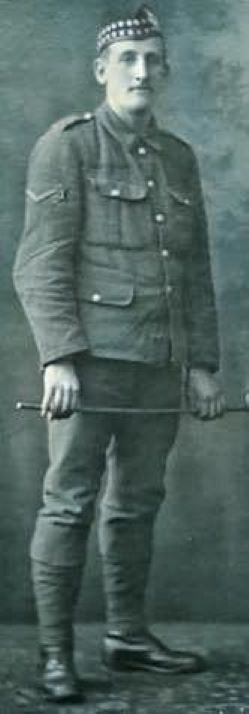
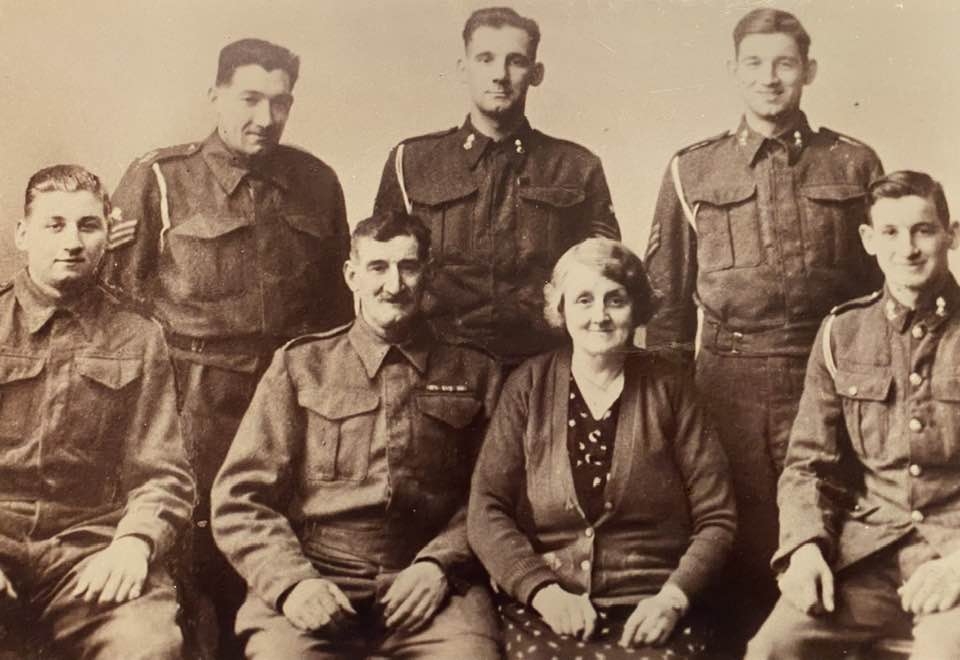
In total, five sons and a son-in-law of Mary Nisbet, a recent widow living at 13 Front Street in Cuthill, Prestonpans, East Lothian, would take up arms against Germany and its allies during the Great War. Two of Mary’s boys, Samuel and James, would remain forever beneath those foreign fields. A third, Robert, would come home badly broken in body, dying not long after the war as a suspected consequence of his service.
Shortly after the outbreak of war, Samuel Ferguson Nisbet was summoned for active service as a reservist with the Royal Scots on 17th August 1914, in the first wave of patriotism that swept the country. He had been previously employed as a miner in Prestongrange Colliery, the same mine where his father had been killed in an accident in 1910.
As a reservist, Samuel would have been warmly welcomed by the recruiting office. But rather than being placed into his previous regiment, Samuel was posted to the Kings Own Scottish Borderers. His military record reveals that he spent the first year of the war in the 3rd (training) Battalion of the KOSB, his previous military experience advancing him to the position of Acting Lance Sergeant by August 1915, helping to shape up the new recruits.
At some time after 1st January 1916, Samuel went to France spending the next year moving between the 7/8th and 6th battalions, alternating in rank between Acting Sergeant and Corporal according to circumstances. In November 1916, he was posted to the 2nd Battalion, reverting in May 1917 to the permanent rank of Corporal “on ceasing to perform the duties of A[cting]/Sgt”.
In France, Samuel was wounded in action with the KOSB on two occasions. On 16th July 1916 he received a gun-shot wound to the left buttock, which would see him sent back to England where he was admitted to hospital in Newcastle. He was given ten days furlough home as a result of this wound on the 15-25th September that year.
On 10th May 1917, he received a gun-shot wound to the shoulder, which would see him hospitalised once again, this time in France, and given a short period of recuperation behind the lines.
The 2nd battalion KOSB war diary for the final days of June and early July 1917, present a picture of an unhappy and weary band of men, heavily depleted in number by illness, injury and death and plagued by unseasonably inclement weather. Here follows the account of key events in the battalion's story at this time...
In the early hours of 1st July 1917, the men of the 2nd KOSB battalion attempted to relieve the exhausted troops of the 1st Norfolk and 1st Bedfordshire Regiments in the front lines at Oppy Wood, near Arras. The diarist described the scene: "It was a wet night and our men, who had had a long and tiring march from our camp, made slow progress, proceedings were also much hampered by having only one communication trench." The Norfolks were relieved first, by B-Company of the 2nd KOSB, and then some companies from the Bedfordshire Regiment were relieved by C and D-Companies of the KOSB. However, many of the Bedfords were found to be scattered in “isolated posts” that required the KOSB troops to cross dangerous open ground where “the enemy snipers were very active.”
The relief force eventually succeeded in making it to these forward positions, but the Bedfords found that they were unable to withdraw due to continued enemy sniping. The exhausted men of both regiments were pinned down and forced to settle in together in the cramped conditions. As the daylight emerged, the enemy artillery began to heavily shell the British positions at intermittent intervals and casualties began to mount up. The last remaining Bedfords were able to withdraw under cover of darkness at 11.30pm on 1st July and the men of the KOSB set to work repairing the shell damaged trenches and dugouts, and digging a new communication trench to link up the positions. This work continued right through into the next day, 2nd July, as both British and German artillery rained down around them.
Samuel had re-joined his battalion in the front lines on 25th June 1917. His file records that one week later, on 2nd July, he was shot in the head and, once again, in the left buttock...he died of his wounds in a Casualty Clearing Station that same day. Sadly, it’s not possible for us to know, unless other evidence comes to light, under what exact circumstances during this time near Oppy Wood, Samuel received his mortal wounds.
His military records retain copies of two telegrams, one to his regimental HQ, the other to his mother, informing the recipients of his death. In a mere 26 words the latter baldly states: "Much regret to inform you that your son 7069 Cpl S.Nisbet 2/KOSBdrs died 2nd July of gunshot wound head and left buttock in No41 Casualty Clearing".
In late November 1917, Mary Nisbet would receive a small package containing a few of Samuel’s possessions, including his identity discs, some letters and coins, a watch in its case, some scissors and a purse. His War and Victory medals, commemorative plaque and scroll would follow after the war.
As she would do for his brother James, Mary chose to have the inscription “Mother’s Loss, Heaven’s Gain” added at the foot of her 27 year old son, Samuel's, headstone in the Duisans British Cemetery in Etrun, France. His home town would soon after honour him and his two brothers with a place of permanent remembrance on the town’s public war memorial.
DONATE TO OUR CHARITABLE FOUNDATION
Your donation supports projects like this one, which educate and involve future generations in remembering those who fell in the two world wars. Your support helps us keep their stories alive. Thank you.
