

PRIVATE WILLIAM HUBERT DARWIN 16421, 1st BN., KING'S OWN YORKSHIRE LIGHT INFANTRY

- Rank
- Private
- Name
- WILLIAM HUBERT DARWIN
- Regiment
- King's Own Yorkshire Light Infantry
- Date of Death
- Died 03 October 1918
Hubert (as he was known) was the eleventh of thirteen children born to John and Jane Darwin.
Originally from Leverton in Nottinghamshire, John had worked variously as farm labourer, groom, coachman and woodman forester. Remarkably for the time all thirteen children survived until at least 1911. He lived in several different villages in the area, but all in the same area – Clayworth, Osberton and Mattersey with Hubert being born in Everton.
Hubert was born in early 1896 and started work as a horseman on a farm, living as a servant in the household of Charles Gauntley, a shepherd, and his family.
By the time he enlisted he was working as an engine cleaner for the Great Northern Railway at the Carr Loco Shed in Doncaster. He enlisted within a month from the 4th of August 1914.
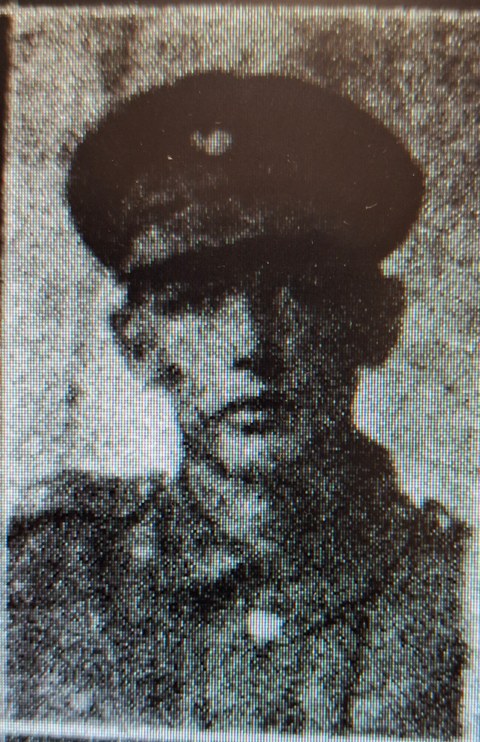
The 1st Battalion of the KOYLI had arrived in France in January 1915 and we know Hubert joined them in September 1915 as he landed in France on the 9th of that month.
On 26 October, the battalion, as part of 28th Division, sailed from Marseilles for Salonika, arriving there on the 7th of December.
During 1916 and 1917 the Division saw plenty of action including the occupation of Mazirko, the capture of Barakli Jum’a and some nearby important trenches, as well as the capture of Barakli and Kumli.
On 20 June 1918 the battalion left 28th Division and sailed, landing in Taranto in Italy in 2 July. Travelling northwards into France, they were now attached to the 50th (Northumbrian) Division. This had incurred heavy casualties as a result of the German Spring Offensives of 1918 and was exhausted. The Division was rebuilt with the original units leaving to rebuild their manpower elsewhere and others, like the 1st KOYLI, arrived to take their place.
It took until October 1918 that the Division was in a state capable of taking the field again. From mid-September to 12 October 1918, the British Army carried out very large-scale offensive operations to break through the Hindenburg Line. These victories are considered some of the greatest British military achievements.
Although the Germans fight on, they are short of men, and, perhaps more importantly, equipment and are driven further and further back.
50th Division was part of these actions, starting the Battle of St Quentin Canal (29 September – 2 October), but the 1st KOYLI was not involved. However, they were heavily involved on the first day of what is known as the Battle of Beaurevoir (3 – 5 October).
The map shows the various fortified lines of the Hindenburg Lines and indicates the starting point of the advance from early August through to early September. Starting from a line through Arras and Albert they had advanced to a line from Arras, through St Quentin to Fismes, at the bottom of the map by 9 September.
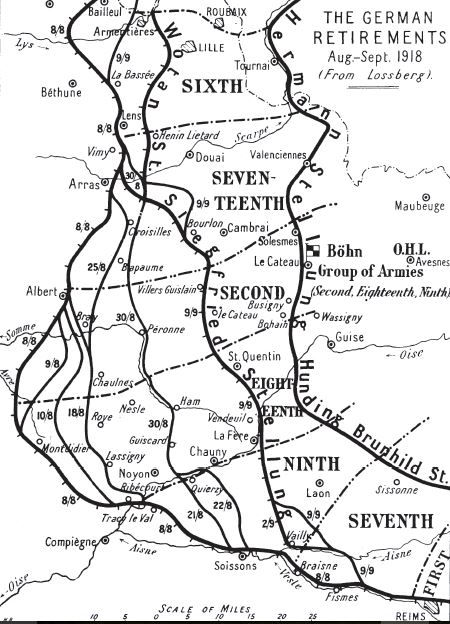
Just above St Quentin is the village marked on the map as “Le Cateau” – I believe this should actually read Le Catelet – Le Cateau is marked close to the words “Böhn Group of Armies”.
The Battle of Beaurevoir would be fought somewhere just above the ‘teau’ of the incorrect “le Cateau” and below the ‘Bu’ of Busigny. The battalion’s war diarist is brief with his descriptions to the extreme. This is the diary entry for the 3rd:
“Battalion moved to ‘jumping off’ line to attack enemy objective – Prospect Hill – objective gained 10.00am. Encountered heavy 5.9” barrage N.E. Bony.”
“Casualties: 2 officers, 42 others. Wounded: 7 officers, 145 others. Missing: 3 others.”
“Prisoners: 3 officers, 205 other ranks belonging to 11th, 81st, 84th, 86th, 88th Infantry regiments and 2nd Guards Regiment.”
“12 midnight: Relieved by 7th Wiltshire Regiment, moved to Hindenburg Line, south of Bony.”
This was a major action and he described nothing of it save for the barrage of 5.9” shells.
Herbert was one of the 42 other ranks killed in the taking of Prospect Hill.
Sorting out his Dependant’s Pension is not straightforward as there are no less than 4 record cards, most of which also include his brother George who also died in the war.
It appears a pension of 5/- per week was awarded from 5 August 1919, but towards the end of November 1919, his mother, Jane refused the award. A single payment of £27 10s 8d was paid to his mother in May 1919, £24 of this was the War Gratuity and the balance amounted to his unpaid pay and allowances.
Herbert was entitled to the 1914-15 Star and the British War and Victory Medals.
He had originally been buried in Gouy British Cemetery (a few miles to the east, near Le Catelet). It was made by the new 50th Division in October 1918 and contained the graves of 127 soldiers from the United Kingdom (almost all from that Division) and one from Australia; the dates of death were the 3rd-10th October, except for one soldier who died on the 18th. Le Catelet and Gouy were captured by the 50th Division on the 3rd October 1918.
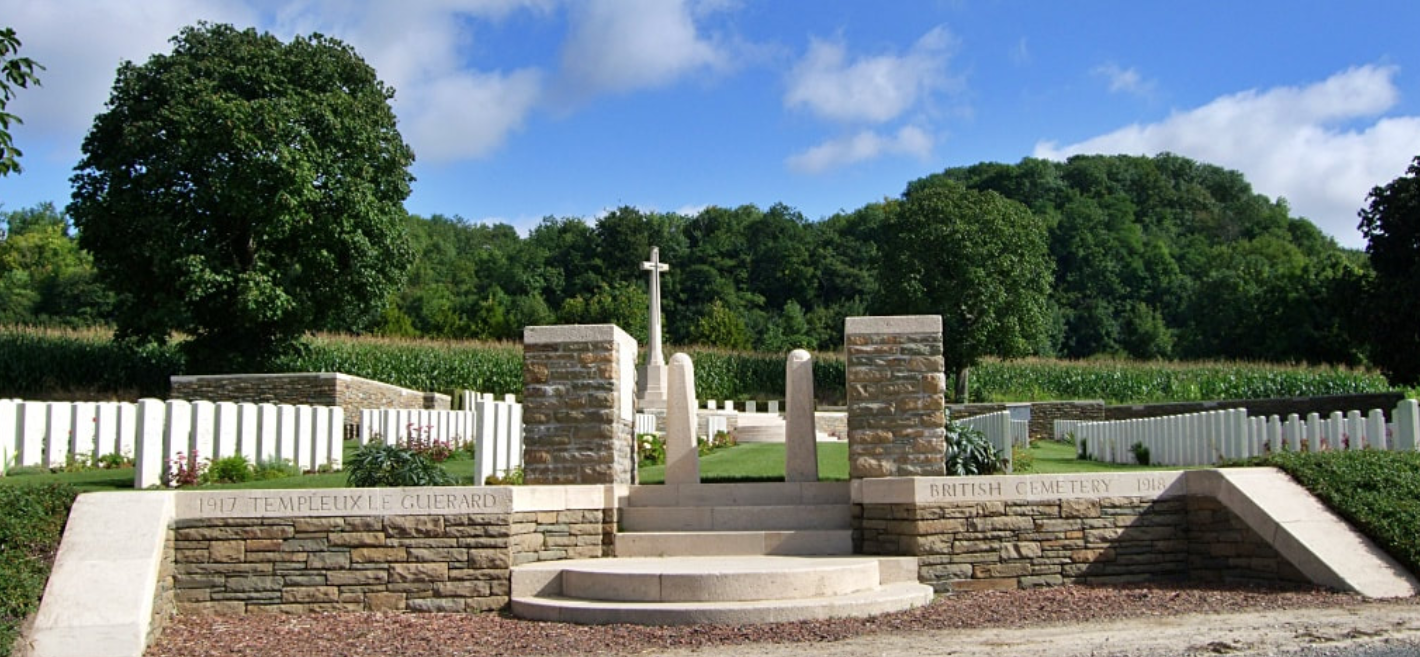
Gouy British Cemetery was closed after the war and the burials (including Herbert) concentrated in Templeux-Le-Guerard British Cemetery, about 26 kilometres east of Peronne.
Loading map…

Support the Foundation
By donating to our Charitable Foundation you help us deliver projects like For Evermore, which educate and inspire future generations to remember those who gave their lives in the two World Wars. With your support, we can keep their stories alive and ensure they are never forgotten