

Black History Month 2026: Honouring Our Communties
Black History Month 2026 celebrates the Black communities which shape, support, and sustain our wider society.
We’ll be looking at the important contributions Black servicemen and women made during both World Wars and how they became part of the wider British military community.
Why We Mark Black History Month
Black people from the UK, the Caribbean, across East, West, Central, and Southern Africa, and elsewhere served in many different roles in wartime.
Their experiences were not universal. Recruitment, opportunity, discrimination, and personal choice differed between communities and places.
Join us as we explore Black communities in the World Wars for Black History Month 2026.
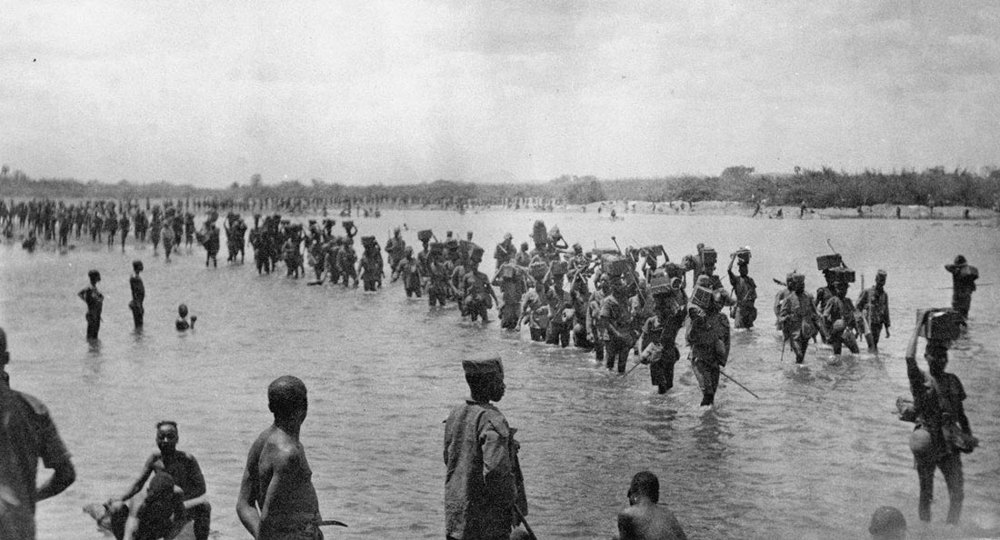 Image: Men of the Sierra Leone Carrier Corps (IWM)
What does “Honouring our Communities” mean for CWGC?
This Black History Month, we are recognising the important and varied contribution Black people made to the British war effort in both the First and Second World Wars.
A theme about people, not just places
Black communities from across the Commonwealth gave service during the two world wars: with service personnel coming from Jamaica, Trinidad and Tobago and the Bahamas, Kenya, Sierra Leone, South Africa, Tanzania, Nigeria, and Ghana to name a few.
But the experiences of Black communities across the British Empire is more than just about places: it’s about the people.
Hundreds of thousands of Black and mixed-ethnicity men and women served in support of the global war effort. We are proud to commemorate all those who died in military service during the World Wars.
No single Black service
More than 700,000 Black Africans served in the First World War, with tens of thousands more coming from the Caribbean. A further 500,000 black and mixed-ethnicity individuals served in the Second World War.
But service was different among different communities. Some saw men volunteer in the tens of thousands to join the war effort; others were pressed and conscripted into service, often serving in terribly harsh, difficult conditions.
You can find tales of Black and mixed-ethnicity servicemen and women in many theatres worldwide: from frontline First World War combat in East Africa and the Middle East, labour and support units working worldwide, to action in Burma during the Second World War, to the Merchant Navy, and soaring in the skies with the Royal Air Force.
Black World War experiences are as different and varied as everyone who served.
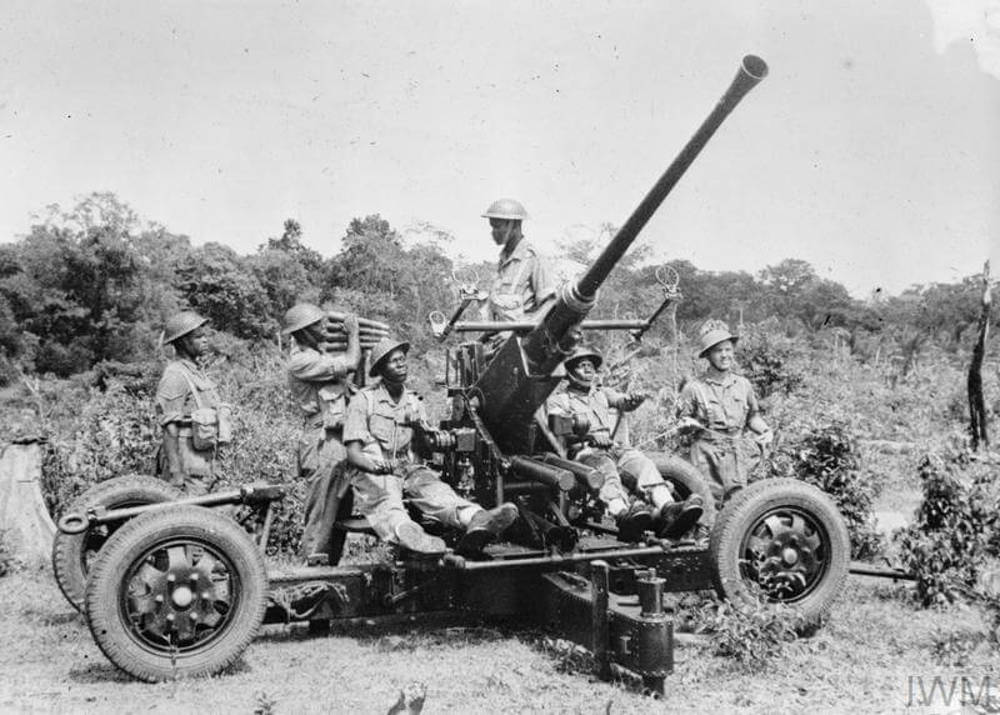
Image: IWM (SE 224) Askaris of the 11th East African Division at a battle training centre in Ceylon receiving instruction on the 40mm Bofors anti-aircraft gun, 1944.
Beyond Combat: The Contributions that Often Go Unseen
The contributions of Black communities in the World Wars have sadly often been overlooked. Nevertheless, these individuals all played an important role in frontline, support and logistics, nursing, and merchant transport.
Carriers, porters, and transport
Regiments like the Sierra Leone Carrier Corps, South African Labour Corps, and a multitude of others performed vital transport, carrier, and logistical operations in the First World War.
In theatres such as East Africa, where motorised transport was unsuited to the terrain and animals vulnerable to the tsetse fly, manpower was the only option.
Essentially coerced and pressed into service, these men braved illness, harsh terrain, and high temperatures, going unarmed to provide the frontlines with equipment, medical supplies, food and water, and to ferry the dead, dying, and wounded from the front.
Labour and logistics
Elsewhere, regiments like the British West Indies Regiment (BWIR) were active on the Western Front and in the Middle East, providing the same important logistical and portering support. The BWIR also saw combat on the frontline in the Middle East Campaign.
Their duties involved digging and repairing trenches, lumberjacking, road building, and so on, as well as ferrying supplies to and from the front.
Black units were barred from fighting on the Western Front, as it was feared that allowing colonial soldiers to fight alongside white Commonwealth troops would undermine British colonial rule.
Medicine and nursing
Some Black and Commonwealth women chose to join local hospitals or volunteered with the Red Cross Volunteer Aid Detachment (VAD). Unfortunately, the colour bar precluded these women from joining the mainstream military nursing services.
By the mid-1940s, women from countries like Jamaica, Guyana, Nigeria, and Trinidad were working in hospital wards throughout the UK, caring for soldiers and civilians caught up in enemy air raid action.
These pioneering women paved the way for later Black nurses, such as those from the Windrush Generation who emigrated to the UK post-war.
Service in the air and at sea
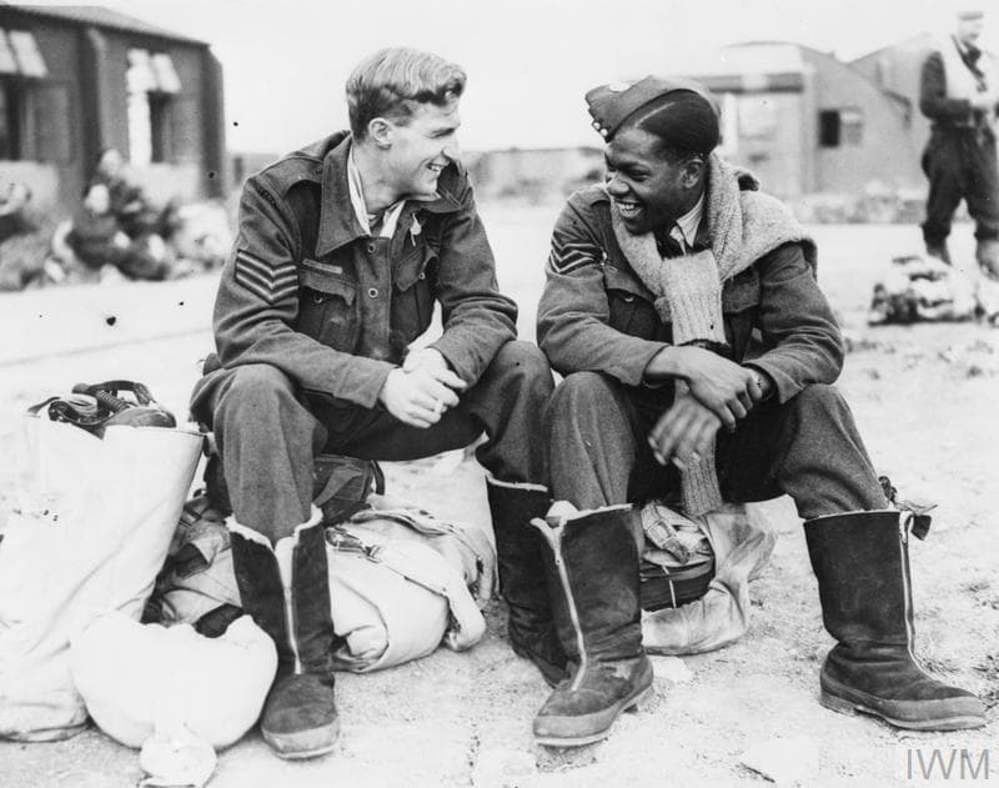 Image: Leslie Gilkes, right, with a crewmate (IWM)
In October 1939, following the outbreak of the Second World War, the British government lifted the “colour bar” for service in the armed forces for the duration of the conflict.
While the formal bar to service was lifted, prejudice and discrimination continued. The RAF was more accepting of Black and others of non-white heritage joining the service. Still, the Air Ministry had to issue the following Confidential Order in June 1944 stating:
“All ranks should clearly understand that there is no colour bar in the Royal Air Force…any instance of discrimination on grounds of colour by White officers or airmen or any attitude of hostility towards personnel of non-European descent should be immediately and severely checked.”
At least 6,000 Caribbean men and 80 women volunteered for the RAF and Women’s Auxiliary Air Force (WAAF). Thousands more made their way from East and West Africa to join.
A further 5,200 men enlisted in the West African Air Corps, a local auxiliary force supporting RAF units based in Nigeria, Gold Coast (Ghana), Sierra Leone and Gambia.
Their duties included piloting fighter and bomber aircraft, joining ground crews, or transporting aircraft to and from factories, repair yards, and the front.
The Royal Navy was more reluctant to recruit Black sailors. Despite a temporary lifting of the colour bar in October 1939, the Navy was slow to recruit anyone of non-White European descent.
Gradually, this changed with Black and mixed-ethnicity sailors serving aboard. Elsewhere, regiments such as the Trinidad Royal Naval Volunteer Reserve supplied ratings and sailors to perform a variety of duties.
In 1947, the colour bar, which had been lifted for the “duration of the conflict”, was finally abolished.
On the frontlines
While the majority of Black servicemen took support roles during the First World War, some regiments fought on the front lines, particularly in the sprawling East African Campaign.
Among them was the King’s African Rifles (KAR), which drew in recruits from across East Africa, such as Nyasaland (Malawi), Kenya, and Uganda. The KAR grew drastically throughout the First World War, reaching a peak size of 30,000 men and up to 24 Battalions.
Against the forces of Imperial Germany, the KAR served in major East African battles such as Latema Nek, Narungombe, and Mahiwa.
Several black formations fought in Africa and the Far East Campaign of the Second World War, including the 81st and 82nd (West Africa) Divisions, the 11th (East Africa) Division, and the Independent 22nd and 28th (East Africa) Brigades, with as many as 90,000 African men serving in Burma.
The people behind the history
Discover some of stories of service personnel from Black communities who served in the World Wars.


From overlooked names to equal commemoration
Why some people did not receive equal commemoration
After the First World War, inherent, systemic prejudice precluded many non-White servicemen from equal, named commemoration, despite this being one of the founding tenets of the Imperial War Graves Commission.
Often, records were not kept for Black servicemen, or if they were, the proper cataloguing and record-keeping was not upheld until years after the war, if at all.
Elsewhere, ignorance, misunderstanding of, and culturally conflicting funerary and burial customs meant the final resting places of Black servicemen were either not recorded or were not permanently maintained, with their point of commemoration transferred to central memorials.
A 2025 report from the Non-Commemoration Programme team found no systematic exclusion from commemoration for non-White servicemen and women during the Second World War. However, inequities remained in the commemoration of certain communities, including Black Africans.
What CWGC research has found
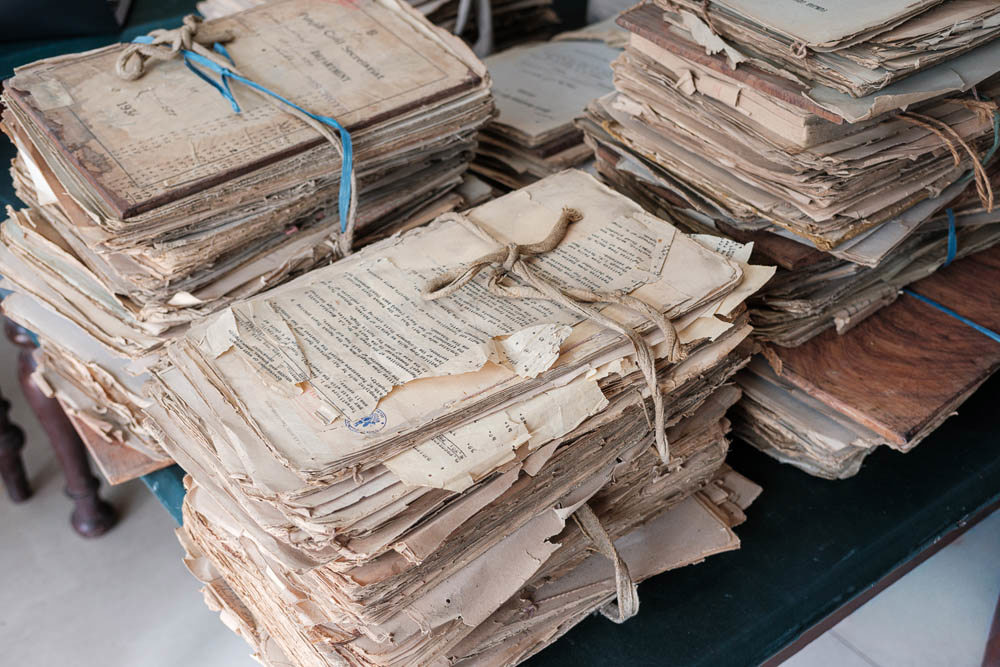 Image: Our historians have worked in archives around the world to uncover the names of previously non-commemorated individuals
Following the findings of the Special Committee in 2021, a significant portion of work carried out by our Non-Commemoration Programme has been to address historical inequalities in commemoration after the World Wars has included archival research.
One such project was to seek to clarify the total number of deaths during the East African Campaign of the First World War. This was important as, within the general historiography, it is common to see general figures offered. Yet these numbers are not merely statistics, but individuals who served and died, but have until now have not been fully accounted for.
By drawing together research from across archives in East Africa and the UK, it is now possible to show that 88,000 East African personnel died in British imperial service during the East Africa Campaign.
This figure still speaks to the magnitude of those who never came home, but hopefully also restores some dignity and individual recognition to each person who lost their life in British military service during the war.
What is changing today
The Non-Commemoration Programme is now part of our business-as-usual work.
Our historians continue to collaborate with research organisations, archives, governments, and military authorities as part of our ongoing mission to properly commemorate by name each previously non-commemorated serviceman where possible.
As our work progresses, we hope it is raising awareness of the contributions made, and the sad loss of, so many Black and mixed-ethnicity individuals from across the Empire in wartime.
Restoring names to the historical record
Since the inception of the Non-Commemoration Programme in 2021, over 20,000 names have been added to our records, ready for inscription on headstones, grave markers, or war memorials where appropriate.
Recent work has seen the names of more than 4,500 members of the King’s African Rifles entered into our records. From these records, we have been able to learn so much more about the individuals who served, and through our collaboration with the Kenya Defence Forces, we have been able to digitise and make publicly available over 8,500 historic records that were long thought to have been lost.
Our work continues as part of our everyday historical and commemorative research. As new names are uncovered, they will be added to our records and appropriate modes of commemoration will be decided on.
Black Communities in the places CWGC cares for

Cape Town Labour Corps Memorial
Inaugurated in 2025, the Cape Town Labour Corps Memorial commemorates over 1,700 members of the South African Labour Corps.
Dean Jay Architects has created an original immersive design using African Iroko hardwood and South African Rustenburg granite bases.
The concept has been brought to life by talented South African crafts people and specialists.

Freetown Memorial, Sierra Leone
The Freetown Memorial is undergoing a radical new glass intervention to commemorate members of the Sierra Leone Carrier Corps by name.
A glass pyramid, etched with 946 Carrier Corps names, surrounds a beam of light, shining into the sky.
The new World War One memorial offers a form of redress and creates a permanent home to honour the men, confronting past inequalities.
Learn more
Hollybrook Memorial
Adorning the Hollybrook Memorial are the names of over 600 men of the South African Native Labour Corps who tragically died when the SS Mendi sank off the Isle of Wight in February 1917.
Each year, we host BHM events at Hollybrook to share the stories of the men who travelled so far from home, only to lose their lives in a tragic ship collision.
What’s fascinating is that Lord Kitchener, Minister of War and possibly the most senior British figure to die in the First World War, is commemorated on the very same memorial, demonstrating CWGC’s equality in commemoration.
Learn more
Runnymede Memorial
The Runnymede Memorial commemorates the Commonwealth airmen of the Second World War who died over Northwestern Europe but have no known grave.
Pilots and airmen from Nigeria, Trinidad, Jamaica and beyond are commemorated alongside British, Australian, Canadian, Indian, New Zealand, and South African airmen at Runnymede.
Among their number is Sergeant Leslie Gilkes of Trinidad. A member of No.9 Squadron RAF, Leslie was killed in action alongside his crewmates when his aircraft was shot down over Hamburg, Germany.
Learn moreCommunities shaping commemoration today
Today, our work continues with Black communities at home and abroad to spotlight their ancestors’ service, work to uncover new names, and engage with them on our commemoration.
Working with communities in Sierra Leone
Freetown project involved local consultation, heritage specialists and plans for satellite memorials in provinces from which Carrier Corps members were recruited. The project is explicitly designed to connect commemoration with local communities.
The reimagined Freetown Memorial is both an extension of the existing memorial and an act of commemorative redress.
Designed by Oshinówò Studio, it transforms the Lutyens monument in Freetown using a contemporary glass structure dedicated to the men of the Sierra Leone Carrier Corps whose identities were omitted from the original monument.
Creating commemoration with local meaning
On recent projects such as the Freetown Memorial extension and the Cape Town Labour Corps Memorial, we have worked with African design studios and local construction companies to create memorials rich in cultural meaning.
Each serviceman is represented by an individually named African Iroko hardwood post set into South African Rustenburg granite, a material that is commonly used in our sites around the world.
By working in such a manner, we are creating sites that inspire but sit perfectly within a local, modern context, and experiment with architectural forms more in keeping with the cultures behind the men and women they commemorate.
Each project also involved working with local communities.
For the Cape Town Labour Corps Memorial, we engaged South Africans and military veterans on the location and developed a memorial using local design and materials, with descendants also represented during the project.
Descendants, researchers, and local voices
The ‘Voices of the Past’ project saw over 50 oral history interviews undertaken with Second World War veterans in Malawi, Kenya and Tanzania. In Kenya, these interviews were undertaken by students, who received training on proper techniques, so as to allow them to learn directly from the experiences of these Second World War veterans.
These interviews are of immeasurable value, as these veterans are amongst the small number now remaining who can speak of their experiences in the Second World War. Experiences which, for a variety of reasons, are not often widely known. By undertaking these recordings, we can now ensure that the actions of these men, as spoken in their own words, will be preserved and can be given a greater voice than ever before. Their stories, and those of their fallen comrades, will always be remembered.
New generations discovering these stories
As part of our ongoing outreach and education work, we continue to work with schools and universities at home and abroad to connect communities with the stories of Black servicemen and women.
For instance, following the unveiling of the Cape Town Labour Corps Memorial, we worked with the South African Elevate programme to reach 4,000 high school students through innovative education technology initiatives.
The workshop used inclusive, multi-lingual, immersive headset technology to highlight historical inequalities, but importantly, encourage reflection through a contemporary lens.
Elsewhere, we have created a suite of in-classroom resources based on Black World War history for use at key learning stages.
We also host an extensive collection of Black and mixed-ethnicity servicemen and women on For Evermore: Stories of the Fallen, our online digital archive. Accessible anywhere, at any time, For Evermore is a brilliant platform for reading and sharing the experiences and exploits of World War service personnel.
Listen to voices from Black history
Sadly, those we commemorate are no longer around to share their stories and experiences directly with us.
The Non-Commemoration Team has previously taken oral history projects designed to capture voices of surviving veterans, so we may better learn of what they went through, their missing friends, and their wartime experiences.
Veteran voices from Kenya and Tanzania
As part of their research, the Non-Commemoration Team has previously undertaken oral histories and testimonials with some of the last surviving Second World War Kenyan and Tanzanian veterans.
The veterans the team met are amongst the last who can describe what it was to serve. Large numbers of their comrades did not come back.
A sentiment held in all interviews was that, by recording the memories of surviving veterans, we can now seek to give these men, and by extension their fallen comrades, a renewed form of remembrance.
Listen to the Voices of Veterans
Black History Month: Education resources
In cemeteries and memorials across the world, you can discover the stories of those from the Black community who served in both World Wars.
Our resource is designed to provide you with a selection of ideas as to how schools can incorporate the stories of Black service personnel and their contributions to the war effort into their work around Black History Month.
Discover our education resources
Find a name and discover your own connection
Discover your own family connections this Black History Month by browsing our records.
Search a name - Use name, service number, regiment/unit or other known details to browse our records in the Find War Dead tool.
Open the casualty record - Click on a casualty’s name to bring up their individual page. All the commemoration information we hold is on there, which can include regiment or squadron, place of commemoration, and other details, such as parents’ names and place of birth.
Explore the place - Now you know where they are commemorated; visit the cemetery or memorial page. You will be able to find a full list of each individual commemorated at that site and how to find them, as well as a map, directions, and historical information related to each site.
Look for additional family or archive sources - CWGC records are for commemoration only. They do not tell the full story of an individual’s service. To get a fuller picture, you may need to consult military and local archives, newspaper archives, relevant historical societies, and so on.
Add to the story - When you’ve put enough together to create a full story, why not share it on For Evermore: Stories of the Fallen.
Share your stories on For Evermore
Got a story of a relative or ancestor you wish to share? Maybe you’re a private researcher looking into Black service personnel and want to share what you’ve uncovered with the world. Do so on For Evermore.
For Evermore is our online stories archive, collecting and sharing thousands of experiences and tales of the men and women we commemorate.
Head over to For Evermore today to browse hundreds of stories of Black service personnel – and to add your own.