

25 September 2026
Canada’s costly push to victory: Remembering the Hundred Days Offensive, and my family’s sacrifice, 108 years later
The Hundred Days Offensive was the Allies' great push for victory on the Western Front in the final days of the First World War.
Canada was at the forefront of this gruelling but ultimately victorious campaign that finally saw German military power broken in France and Belgium.
CWGC's Alex Carter has a family connection to Canada's Hundred Days. Join us as we examine Canada's role in this pivotal campaign, Alex's family links, and the cemeteries and memorials commemorating Canada's fallen from the Battle of the Canal du Nord.
Canada's Hundred Days
It begins with a name
A couple of years ago, I had a chance encounter with a name on a family tree – Edward Sanderson White. Next to this name was scrawled the words:
“Killed in action”
Edward was my great-great uncle. I knew nothing about him, and my discovery sparked a determination to learn about his life and death.
In this blog, I will share his story, discuss the wider context of the dramatic yet virtually unknown battle in which he fell, and spotlight some of the beautiful but rarely visited CWGC cemeteries that care for the dead he fell alongside, exactly 108 years later.
Edward's Life
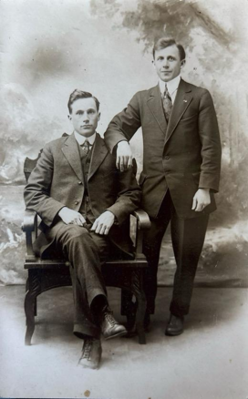 Image: Edward Sanderson White (seated), with my great-grandfather Thomas White, who survived the war
Edward, like so many men who fought for Canada during the First World War, was a first-generation Canadian.
He was born into a large immigrant Irish pioneer farming family who settled in rural southeast Saskatchewan near the end of the 19th century.
He was the youngest boy of 10 children. His parents, Robert and Elizabeth, both hailed from rural County Cavan, central Ireland.
The Whites were a devout Presbyterian Protestant family, many of whom left Ireland in the late 19th century to settle in Canada.
Edward’s family would have been attracted by the promise of cheap land and prosperity, but life was still tough in Saskatchewan.
The nearest school was 6 miles away, with oxen being the only means of transportation.
Edward attended school only in the summer, and his class was small, as can be seen in this photo:
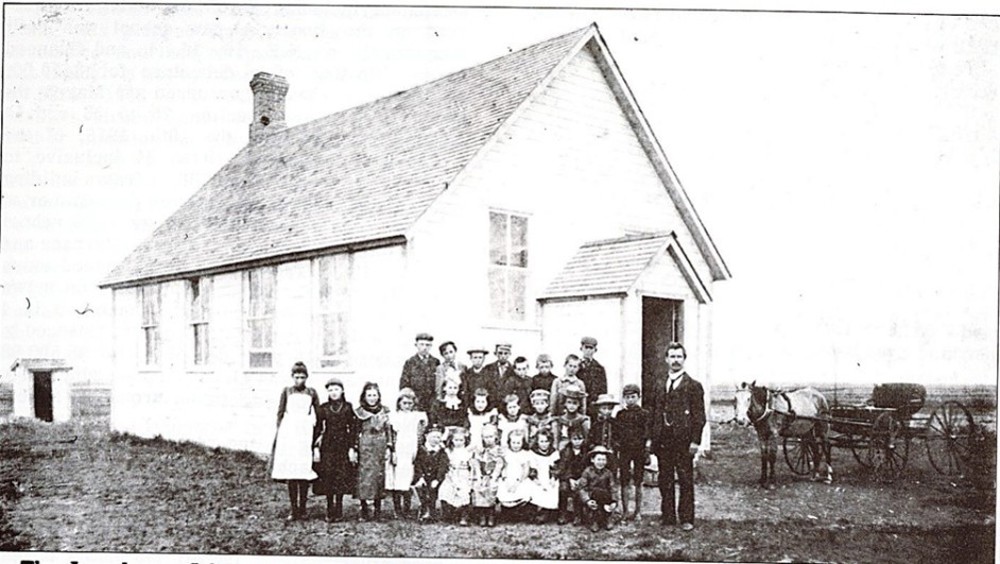
Image: Edward (back row, fourth from right) with his school class, many of whom were his numerous siblings
Joining the army
Edward enlisted in the Canadian Expeditionary Force in the (relatively) nearby town of Moose Jaw on 10th July 1917, at the age of 25. His late enlistment date suggests he may have been drafted.
Initially joining the 60th Rifles of Canada, Edward embarked for Liverpool at the end of January 1918 and was officially taken on strength at Seaford, the location of the main Canadian camp and training area in the UK, at the end of March 1918. After a period of training, he was then transferred to the ‘CMG Pool overseas’ at the end of August, arriving in France and being taken on strength of the 2nd Battalion Canadian Machine Gun Corps a day later.
The Canadian Machine Gun Corps (CMGC) provided machine-gun support and tactical expertise to all four divisions of the Canadian Corps on the Western Front, a highly effective fighting force by the time Edward joined the ranks in 1918.
His battalion, the 2nd, was attached to the 2nd Canadian Division. As a private, he would have been part of a small gun team responsible for operating, transporting, and maintaining a gun emplacement that provided direct and indirect fire on German forces.
As the war progressed, the CMGC garnered a reputation for tactical innovation and fighting efficiency, becoming an indispensable asset in the battle successes experienced by the Canadian Corps.
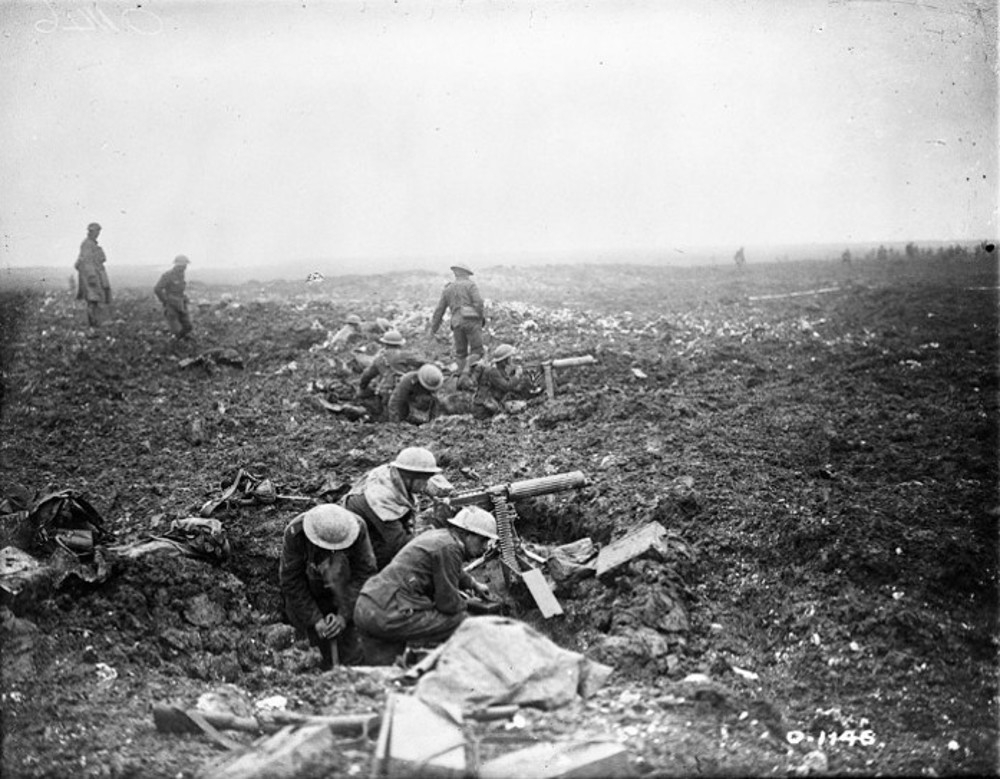 Image: Canadian machine gunners dig themselves in, in shell holes on Vimy Ridge (1 digital object(s)) Archives/Collections and Fonds)

Want more stories like this delivered directly to your inbox? Sign up for our newsletter for regular updates on the work of Commonwealth War Graves, blogs, event news, and more.
Sign UpCanada’s Hundred Days Offensive: Chasing the Germans to victory
When Edward finally arrived in the theatre of war as a fully-fledged soldier in early September 1918, he found himself at the centre of a fast-paced, complex and highly destructive series of Allied offensives now known as the Hundred Days Offensive.
Commencing on the 8th August with the Battle of Amiens and ending at the Armistice, the battles involved a coordination of men and complexity of tactics never seen before in the First World War.
The days of trench warfare were well and truly over. This was a war of fast advances and elaborate manoeuvres.
Whilst many Allied forces played a vital role, the Canadian forces in which Edward fought were consistently at the forefront of these battles, under their highly effective commander, Lieutenant-General Arthur Currie.
The Canadian Corps, consisting of four ‘heavy’ divisions, punched well above its weight in this period, defeating a quarter of all German forces across the Hundred Days.
But this came at a cost. The Canadians suffered a quarter of all their First World War casualties in this period, a staggering 45,000 men in just 3 months.
Let’s have a look at the battle that led to Edward becoming part of that grim statistic, tragically, after just 1 month into his active service.
The Battle of Canal du Nord: An overlooked feat
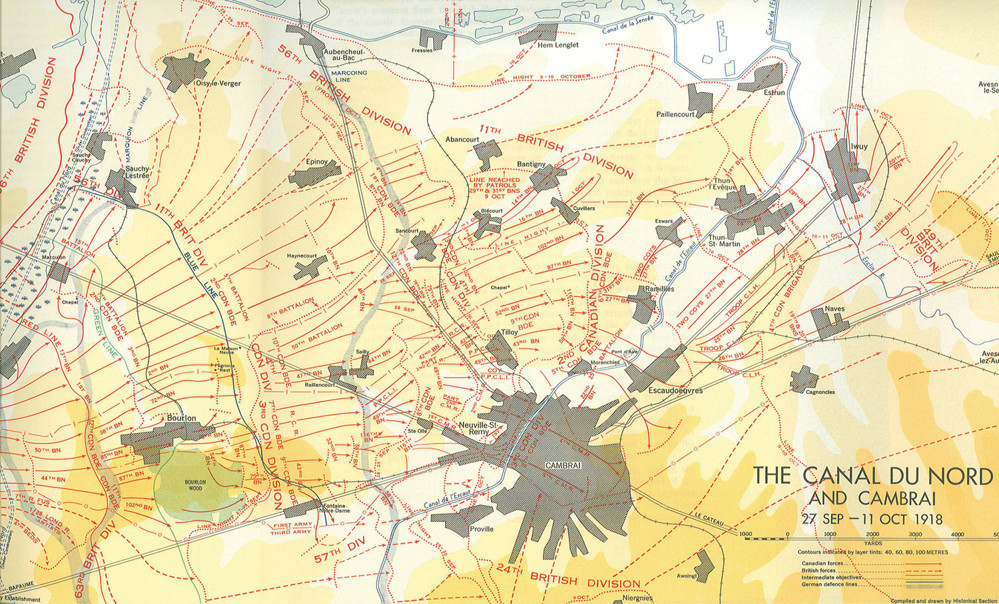 Image: Notice the Canadian line of advance in this map of the Battle of Canal du Nord to see the small area tens of thousands of Canadian servicemen broke through (Canadian Official History)
The Battle of Canal du Nord can be seen as the jewel in the crown of Canada’s Hundred Days – yet it is a battle that simply hasn’t entered the public imagination in the same way as the Somme or Passchendaele.
A daring, ambitious and highly complex operation, it was vital in breaking the back of German defences as Canadian and British soldiers ruthlessly pursued them further and further east past the Hindenburg Line.
It all started on the 27th of September, 1918.
A plan was devised to cross the Canal du Nord: a semi-constructed industrial canal system that was abandoned by the French at the outbreak of war.
It was the last major obstacle in the way of Cambrai, a town that served as an essential transport hub for the Germans, and was a key strategic target to force their defeat.
The canal’s steep banks made it a formidable German asset, and all but a roughly 2-kilometre-long section was flooded and impassable.
General Currie’s plan to get around this was to install temporary bridges across the dry section to allow his artillery and men to cross. This extremely dangerous work, all under the watchful eye of the Germans, was carried out by the Canadian Engineers.
Success here hinged on pulling off something unprecedented: pushing two divisions of Canadians (tens of thousands of men of the 1st and 4th Divisions) through this narrow gap and then repositioning them on the other side to continue the fight.
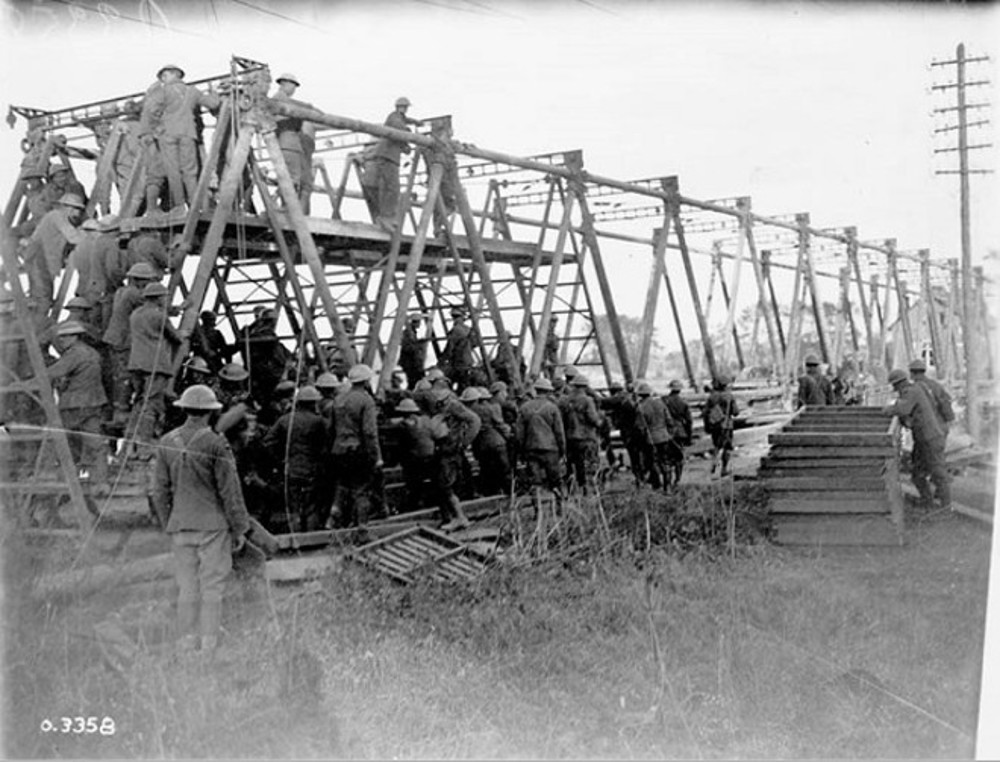 Image: Canadian Engineers building the vital bridges across the Canal du Nord. (Library and Archives Canada-3628666)
The element of surprise was vital and was preserved intact.
At dawn on the 27th of September, the attack began, and the opposite bank of the canal was secured so the artillery could begin to cross.
Troops surged 8km in one day. To put that into perspective, an advance of only 10km was achieved across the 141 days of the Battle of the Somme.
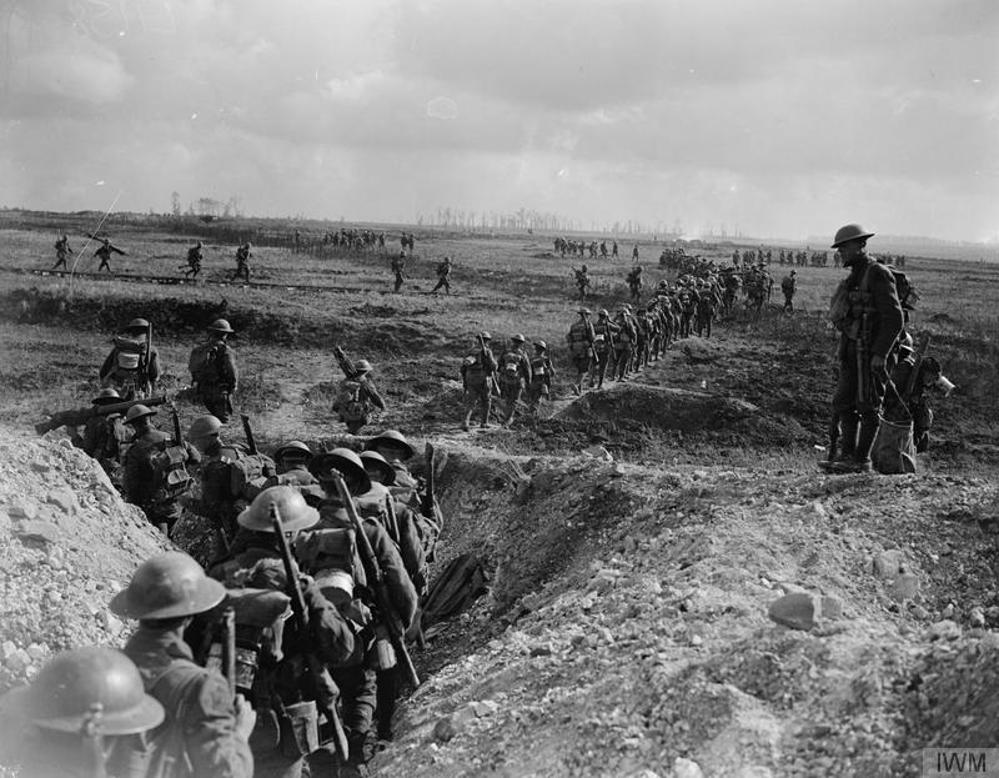 Image: Supports of the 4th Canadian Division go forward into battle, 27th September 1918. IWM (Q 9325)
By the end of the day, the canal was captured, and the Canadians had secured a swathe of land on the other side that included the vital high ground of Bourlon Wood and the village of Bourlon.
From here, Cambrai was in sight, and it was taken – abandoned by the Germans – by 10th October. This really was the beginning of the end of the war.
But German resistance increased as the battle wore on, and increasingly desperate counter-attacks were mounted.
Like all of the successful battles of Canada’s Hundred Days, the victory at Canal Du Nord came with a cost, with over 10,000 Canadian soldiers killed, wounded or missing.
Edward's Death
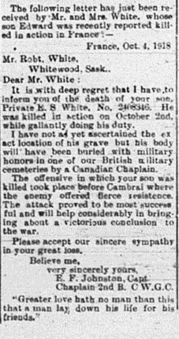 Image: A copy of the letter sent to Edward’s parents by his Chaplain after his death, published in their local newspaper, The Herald
Edward was sadly one of these men.
He met his end on the 2nd October 1918 whilst his Battalion, the 2nd, was in close support of the attack.
The nature of Edward’s role, as a machine gunner providing tactical fire in support of infantry units spread over a large and chaotic area of battle, means I have been unable to find direct reference to the circumstances of his death.
But several clues have helped me reconstruct some of the details.
Edward was one of only four soldiers of his unit killed on this day. The other three were killed by a shell in the vicinity of Tilloy, part of the Canal du Nord battlefield. They were Privates Alfred Roy and Joseph Garneau, both delivery drivers from Quebec, and Private Ray Burns, a cook from Ohio.
This makes it likely that Edward lost his life alongside these men when a shell landed on his machine gun section, or in a trench in which men were gathered in preparation to take over the line.
The Official History notes that around the time of Edward’s death, his division was engaged in a dangerous manoeuvre to take over the line in relief of the 1st Division, whilst under ‘strenuous’ attack from German forces. It is likely Edward was involved in this, and died as a result.
These three comrades are now buried alongside him, so let’s turn the discussion to the cemeteries that tell the dramatic story of Canal du Nord.
The Battle of the Canal du Nord in CWGC cemeteries
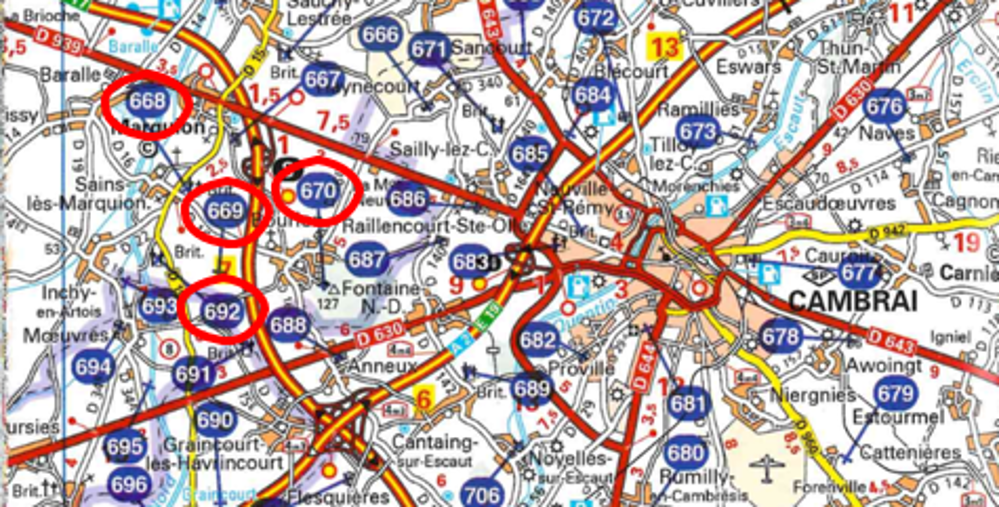 Image: A map showing the density of CWGC cemeteries along the path of the Canadian advance to Cambrai. Circled are the cemeteries I will highlight in the following paragraphs.
The CWGC cares for the graves of the many ordinary men like Edward who fell in the battle across dozens of small, infrequently visited and unique cemeteries that speckle the land between the canal and Cambrai.
This area of the French battlefields is relatively unusual in its high concentration of ‘battlefield cemeteries’, small plots where men were buried more or less as they fell.
The lack of large ‘concentration’ cemeteries means these small burial grounds have remained intact.
This makes for fascinating visits, as the cemeteries tell the story of the battle as it unfolded and Canadian forces steamrolled east along the Arras-Cambrai Road, leaving their fallen behind in hastily established burial plots.
Let’s spotlight a few of them, and some of the men who lie within them. Quite remarkably, one of them is from a group of several men from the very same village as Edward Sanderson White, who were all killed in the same battle.
Sains-les-Marquions British Cemetery
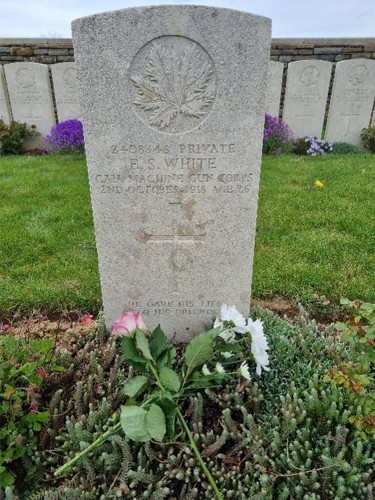 Image: Edward's headstone (taken by the author)
It would be an oversight not to begin with my uncle Edward Sanderson’s own resting place, Sains-les-Marquions British Cemetery.
I have been fortunate enough to visit Edward’s grave myself a couple of times, to remember him and his comrades – a moving experience. The cemetery is calm and quiet, and bordered by beautiful lavender plants.
This cemetery lies just over the Canal du Nord, and roughly marks the northern limit of the dry 2km long crossing point seized on the first day of the battle – the village of Sains-les-Marquions was amongst the objectives captured on this day. Indeed, the vast, flat landscape makes it easy to see the ground the soldiers would have covered.
This site was begun by the 3rd Canadian Infantry Brigade on their freshly captured territory, and now contains 259 burials, many of which (but not Edward’s) were brought in from surrounding battlefields after the war. Most men are Canadians of the 1st Division, but there is more diversity here than in many of the surrounding cemeteries, with British burials too.
Buried alongside Edward are the three aforementioned men who were likely killed alongside him:
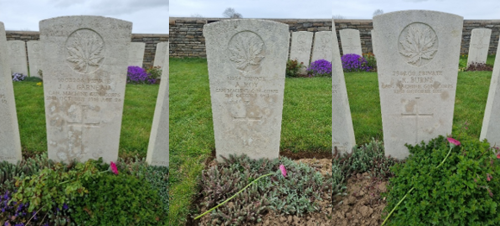
Ontario Cemetery, Sains-les-Marquions
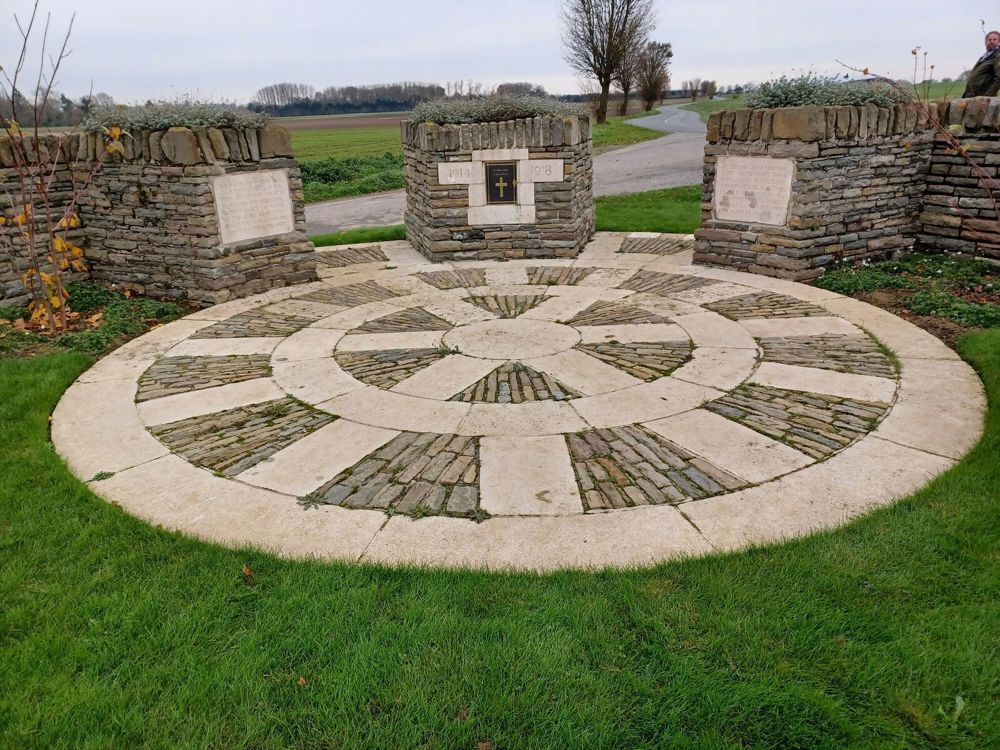
Image: Ontario Cemetery, Sains-les-Marquions's unusual circular entry feature
A stone’s throw south of Edward’s cemetery is the aptly named Ontario Cemetery, which contains the same number of identified burials.
Ground was broken here at a similar time by Canadian fighting units, and as you may expect, it mainly contains the graves of Ontario men of the 2nd, 3rd and 4th battalions of the Canadian Infantry (1st Division).
The majority of these men died on the first day of battle. They were responsible for capturing this area of the battlefield, so many died a stone’s throw away from where they still lie.
This site was designed by one of the Commission’s principal architects, Edwin Lutyens, and bears some unique architectural features, including an unusual circular entranceway:
Quarry Wood Cemetery
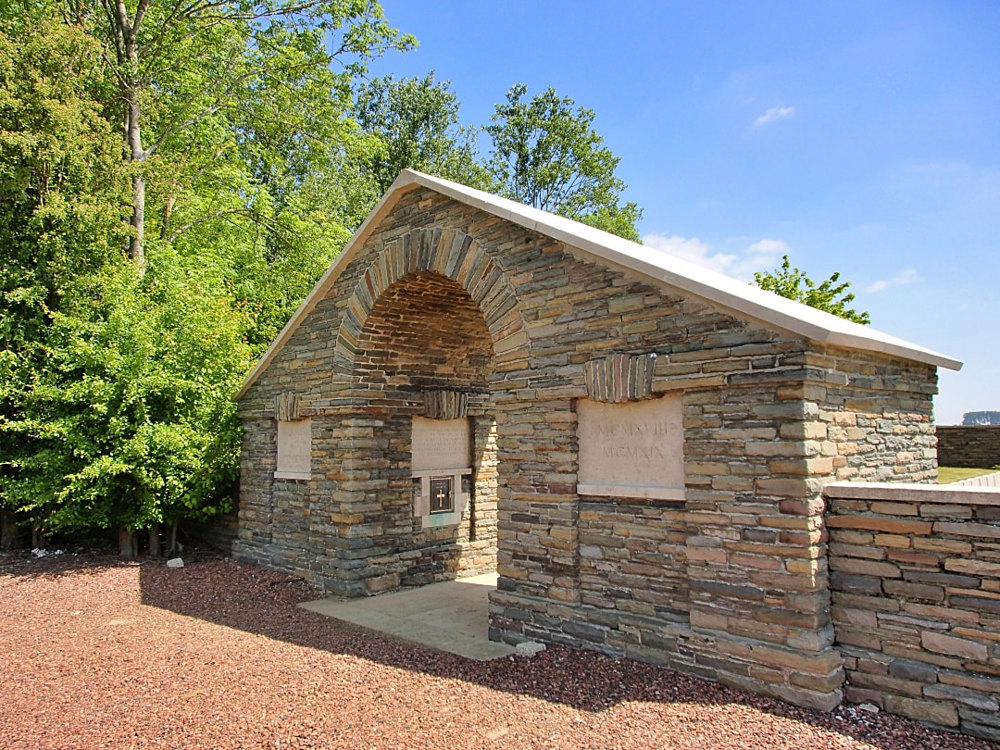 Image: The intriguing stone entry building at Quarry Wood Cemetery
A bit further south of Ontario Cemetery, just west of the village of Bourlon, one can find Quarry Wood Cemetery.
Also a smaller site with similarly distinctive architecture for its size, it has a commanding view over the flat farmland that the Canadian troops would have advanced across on their way to Bourlon Wood.
It was also started at the beginning of October by Canadian forces to bury the dead of the previous days’ fighting to cross the canal, and contains almost entirely Canadian soldiers.
Quite remarkably, a lad from very near Edward White’s own village, Whitewood, is buried here. When one considers the likelihood of two men from a tiny village in Saskatchewan dying within days of each other in the same short battle in entirely different units, this is striking.
His name was Alexander Hall, and he was the son of the village priest. He died of wounds during the attack on Bourlon Wood. You can read his story in more detail on For Evermore, our online collection of stories of the fallen.
Bourlon Wood Cemetery
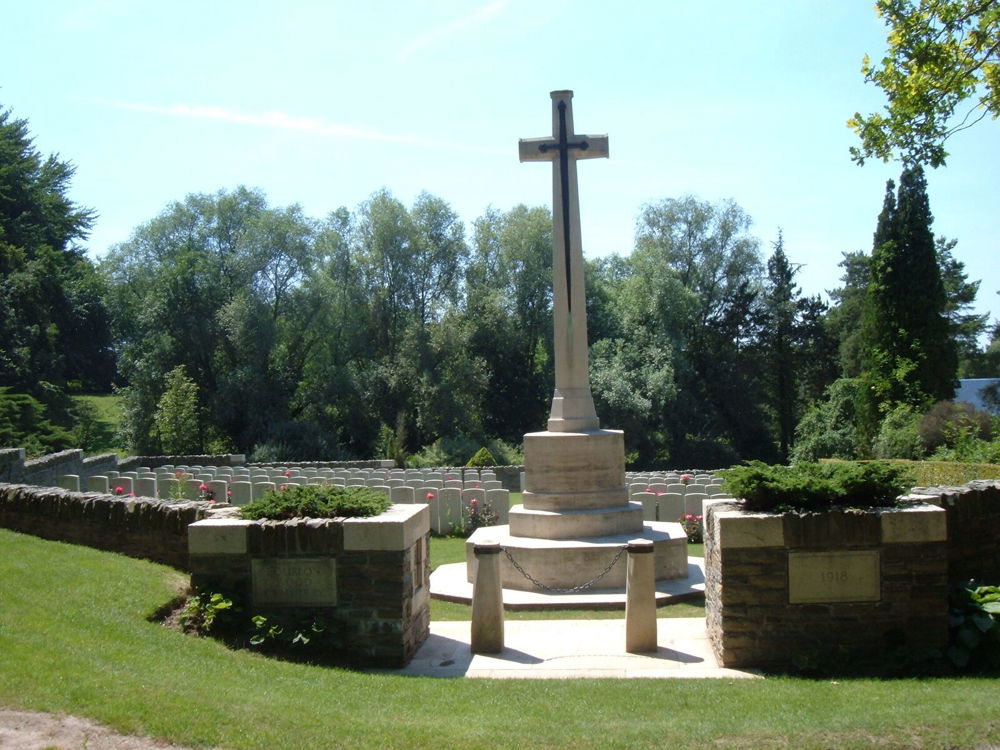
Image: Bourlon Wood Cemetery
Last but most certainly not least, Bourlon Wood Cemetery, nestled amongst the trees of its namesake, Bourlon Wood.
This is a beautiful and serene cemetery occupied almost entirely by Canadian soldiers who died wrestling the wood and it’s associated high ground from German forces.
The graves here are tightly packed, revealing the rushed burial conditions. They largely represent the trickier stage of the Battle of Canal du Nord - the advances over the crest of the hill on this side of the canal.
Started in early October by the burial officers of the Canadian Corps, this cemetery contains around 250 burials, and stands very near the imposing Bourlon Wood Memorial, erected by the Canadian government, which commemorates all Canadian battles in the area from the end of September to the Armistice.
This makes it a natural place to end this blog: at the top of the hill upon which the memorial to so many Canadians, amongst them Edward Sanderson White, stands.