

01 October 2026
Commemorating the Poets of the First World War
The poetry of the First World War is some of the most evocative war literature ever produced.
Capturing the experiences and emotions of Commonwealth soldiers, the war poets gave us insights into this most violent and dramatic of conflicts.
This National Poetry Day, we look at how some of the foremost poets of the Great War are commemorated and why their work still resonates today.
The War Poets of the Great War at a Glance: What’s on this page
This page looks at the life, work and commemoration of war poets of the First World War, including:
Why First World War poets are still studied
How CWGC records connect poems to people
Great War Poets and their work
Where poets are commemorated
How cemeteries and memorials add context
How students and researchers can use CWGC records
How visitors can explore poet-related places
Why First World War Poetry still Matters
First World War poetry is still literary significant and historically relevant in a number of ways.
Words that have shaped public memory
In the immediate decades after the First World War, war poetry was not the popular lens through which the Great War was viewed, as it is for many now.
In the 1960s, however, the 50th anniversary of the war and the inclusion of First World War poetry into O and A level English curricula changed that. With greater exposure, new ideas about using literature as a source for understanding the past, and changing attitudes towards warfare, selected works of poetry from the First World War began to shape public memory of a war fewer and fewer had experienced themselves.
The work of writers like Wilfred Owen and Siegfried Sassoon entered the public imagination, with their prose highlighting individual trauma against the wider violence of the war.
People behind the poems
The people behind the poetry of the First World War were often educated, sensitive men, previously already interested in creative endeavours.
Some had their muse awakened by the conflict, turning previously unrealised literary talent into capturing their emotions via verse.
Today, names like McCrae, Thomas and Rosenberg resonate, but here we will go into some more detail about the people behind the poems.
Wilfred Owen: A familiar name, a specific place
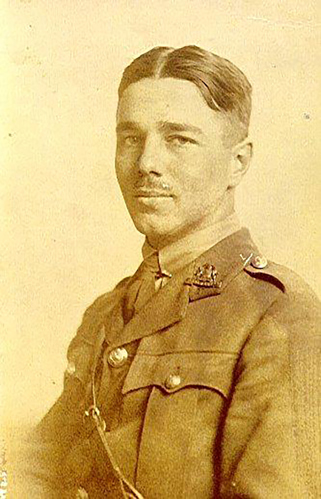 Image: Wilfred Owen (Wikimedia Commons)
Wilfred Owen is one of the most recognisable British First World War poets, with his works featured in the curriculum and poetry anthologies for years.
Who could forget Owen’s immortal verses?
For a certain generation of British schoolchildren, Dulce et Decorum Est is the war poem, with its final stanza, “the old lie: Dulce et decorum est, pro patria mori (how sweet and proper it is to die for one’s country) vividly burned into readers' imaginations.
His poetry has become emblematic of trench life, not glorifying war but presenting it in unflinching detail.
Beyond the Anthology
Owen enlisted in October 1915, commissioned as Second Lieutenant in the Manchester Regiment.
He suffered shell shock after being caught in a trench mortar blast and was sent to the Craiglockhart War Hospital to recuperate.
Craiglockhart was a pioneering facility. The staff were focused as much on healing the soldier’s mind as on their bodies, with psychotherapy aimed at helping servicemen cope with their mental trauma while their physical wounds healed.
At Craiglockhart, Owen met and befriended another of the Great War’s leading war poets, Siegfried Sassoon. Sassoon mentored Owen, helping develop Owen’s artistic voice.
Owen returned to the front line in 1918. He earned the Military Cross for his part in an attack on enemy strongpoints at Joncourt shortly after. Allegedly, Owen always sought such a decoration to justify his position as a war poet.
Sadly, like so many of his contemporaries and those immortalised in his verse, Owen was killed in action. He died on 4 November 1918 during the crossing of the Sambre-Oise Canal, exactly a week after the guns fell silent on the Western Front.
Finding Owen in the CWGC records
Wilfred Owen is easily findable in CWGC records.
Using the Find War Dead tool, you can search by first name and surname.
The search will return all results matching those terms. To narrow your search, you can filter by other fields such as military service branch, regiment, and so on.
Owen’s casualty page will reveal his commemoration information, including his place of burial: Ors Communal Cemetery.
Visiting and exploring Owen’s place of commemoration
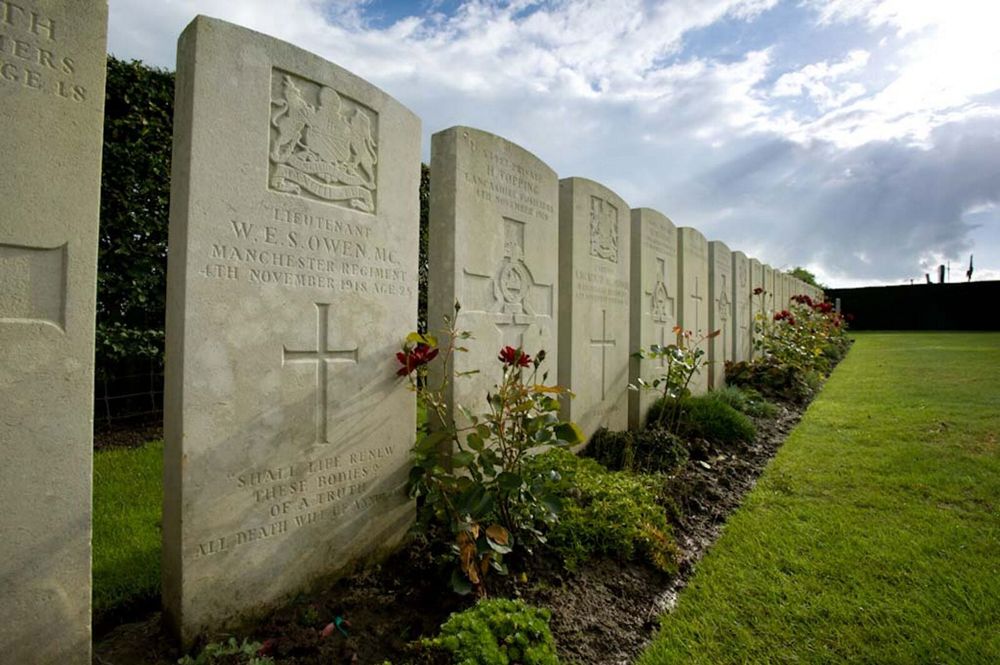 Image: Owen's headstone alongside his comrades' at Ors Communal Cemetery
Wilfred Owen’s CWGC headstone is one of 60 or so installed at Ors Communal Cemetery.
The CWGC plot sits back from the main civilian burial ground, under the arms of our iconic Cross of Sacrifice.
The poet’s own words are inscribed on his headstone. Taken from The End, Owen’s personal inscription reads:
"'Shall life renew these bodies? Of a truth all death will he annul' W.O."
Rupert Brooke: Poetry, Place and Commemoration
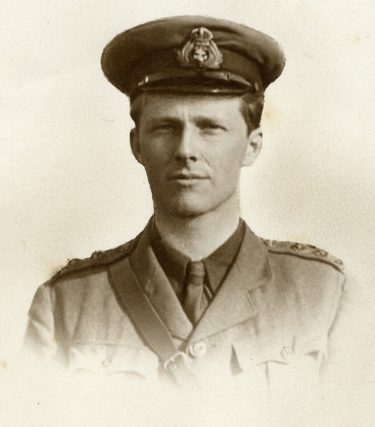 Image: Rupert Brooke as an officer in 1914 (Wikimedia Commons)
British war poetry contains some of the most iconic verses and lines in the war poetry canon, none more so than Rupert Brooke’s 1914 poem The Soldier.
The Soldier uses the form of a sonnet, a style normally associated with romance, becoming a patriotic, romantic ode to military service and England. Its most famous line, paraphrased by everyone from Pink Floyd to Blackadder, reads:
“If I should die, think on this of me:
That there’s some corner of a foreign field,
That is for ever England.”
In contrast with Owen’s downbeat imagery and tone, Brooke casts military service, even dying in war, in a positive light.
Perhaps Brooke was full of these patriotic stirrings as he sailed en route to Gallipoli in 1915. He would never make it.
Rupert Brooke died from an infected mosquito bite aboard a French hospital ship heading to the Dardanelles in April 1915.
A poet many people search for
Such is Brooke’s fame that he is among the most regularly searched-for individuals in CWGC records.
There are thousands of creatives amongst those we commemorate at the CWGC, ranging from war poets to artists and painters, novelists and writers, sculptors, singers and musicians, and a myriad of others devoted to life’s creative pursuits.
It’s often through people like Brooke that we can get a better understanding of servicemen’s mindsets and motivations.
Brooke’s poetry, published earlier in the war, presents a patriotic, hopeful tone, contrasting with the later violent, death-stalked imagery employed by poets like Owen.
It helps us think of the Young Brits and Commonwealth soldiers before they set off: young idealists ready to serve their country, not yet fully exposed to the grinding industrial warfare of the First World War.
But away from his work, Brooke’s war grave is different to the traditional CWGC burial and war grave.
The place connected to Brooke's commemoration
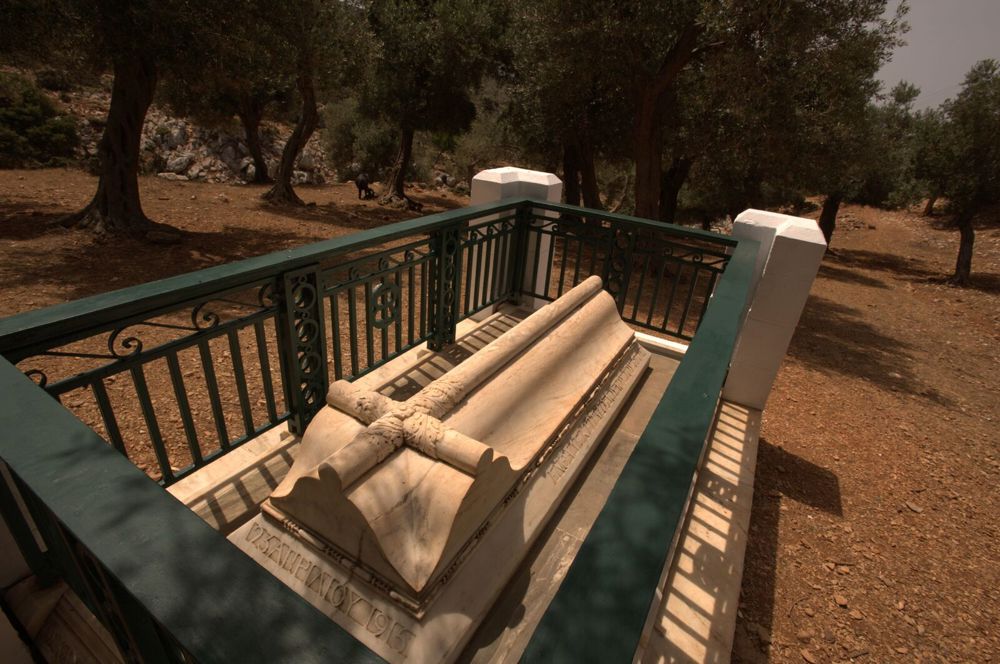
Image: Brooke's tomb on Skyros
Brooke is buried in an isolated grave on the Greek island of Skyros, in a marble-topped, cross-embossed private tomb.
A small group of friends, including the Australian Olympian and composer Lieutenant-Commander Frederick Septimus Kelly, buried Brooke in a private, emotionally charged ceremony.
Originally buried in a small cairn with a wooden cross, Brooke now lies beneath enduring stone nestled in a small olive grove: a corner of some foreign field that is forever England.
What a CWGC record can show
Brooke’s CWGC record shows a variety of details, including:
Name and service number
Regiment and unit
Date of death
Place of commemoration
Extra notes including his personal inscription details
Each casualty page in our records shows the above combination of items, depending on what information we were supplied during our earliest days.
In Brooke’s case, his unusual place of commemoration and tomb can lead users to learn more about the circumstances of the poet’s death and burial.
Isaac Rosenberg and the Individual Voice of War Poetry
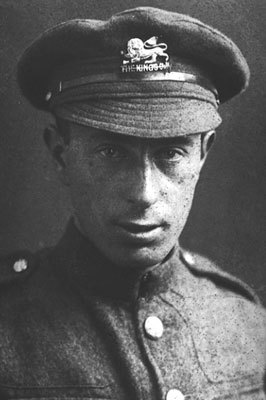 Image: Rosenberg in military uniform (Wikimedia Commons)
Rosenberg, the son of working-class Latvian Jewish immigrants, has been described by the Poetry Foundation as a man of many poetic facets:
“He was a Jewish poet, he was an English poet; he was a war poet, he was a painter-poet; he was a young poet; he was a great poet and a minor poet.”
In a brief career, Rosenberg created a small but powerful corpus of poetry and artwork, although his poetry is mostly focused on his wartime experiences.
Among his most popular poems are Dead Man’s Dump, which vividly describes the chaos and carnage of life in the trenches, and Break of Day in the Trench: a stream of consciousness describing what faced soldiers in dugouts and trenches at the front.
Frequently in ill health, Rosenberg spent time on and off the front line before settling in October 1917 with the 1st Battalion, King’s Own Lancaster Regiment.
On 21 March 1918, the German Army launched its massive Spring Offensive, aimed at breaking Allied lines and winning the war on the Western Front.
A week later, near the town of Fampoux in northern France, Rosenberg sent a last letter home with the poem Through These Pale Cold Days before heading to the front with reinforcements.
After completing a night patrol, Rosenberg was killed on the night of 1 April 1918. There is some debate as to whether he was killed in close combat or by a sniper.
A poet and a named individual
Initially buried in a mass grave, we believe Rosenberg’s remains were recovered when a group of six King’s Own Lancashire soldiers were discovered. Each was reinterred at Bailleul Road East Cemetery in the Pas-de-Calais.
A special memorial to Rosenberg stands within the cemetery, indicating he is buried somewhere close by.
You’ll note the special memorial commemorates Isaac Rosenberg by name; in the same manner we commemorate each serviceman or woman where possible.
Commemoration is tied to named individuals, such as Isaac Rosenberg., Reading the names on headstones, grave markers, or memorial panels invites us to explore the stories behind the names.
In Isaac’s case, we are invited to explore his work, especially as his headstone inscription, “Artist & Poet”, highlights his creative bent.
Records, Identity, and place
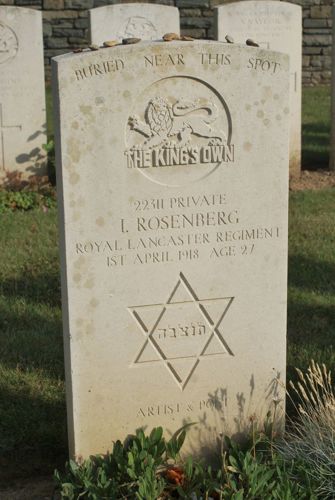 Image: The special memorial indicating Rosenberg is buried close by. Notice the Star of David inscription
While our records do not record religious affiliation, there are some indicators as to Rosenberg’s Jewish identity, particularly on his special memorial headstone.
Although religious information was not recorded as part of our commemoration records, as we believe equality in commemoration extends to religious equality, families were able to request religious symbols on their headstones.
In Rosenberg’s case, it seems his parents specified his to have a Star of David emblazoned on their son’s grave marker.
Commemoration beyond literary fame
Commemoration of Isaac Rosenberg goes beyond his poetry.
His name is forever in our records and etched into a stone special memorial, protected in our records, and his story will be told forevermore.
In addition to his CWGC war grave, Isaac Rosenberg is also commemorated at Poets’ Corner in Westminster Abbey.
Edward Thomas and the landscape of memory
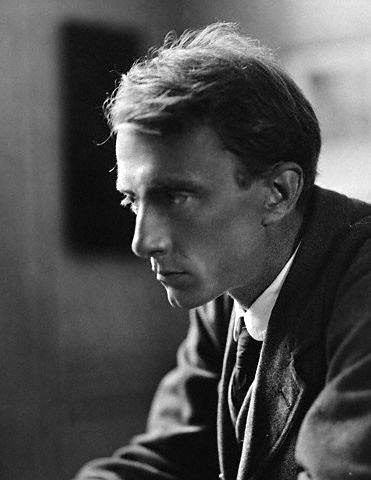 Image: Edward Thomas (Wikimedia Commons)
Philip Edward Thomas was already in his mid-30s when the First World War broke out. He had spent much of his early career as a literary critic and a prolific writer.
Striking up an intimate friendship with American poet Robert Frost and encouraged by him to finally release his own writings, Thomas became a published poet in 1914.
But Frost’s influence would go beyond the purely literary. His legendary poem The Road Not Taken and its fiery rhetoric against indecision provided the catalyst for Edward Thomas to put down his pen and pick up a rifle.
Thomas enlisted in 1915, joining the Artist’s Rifles – a regiment of like-minded creatives who heeded the call. By 1917, Thomas had reached the rank of second lieutenant in the Royal Garrison Artillery. He was sadly killed in fighting near Arras in 1917, leaving behind a powerful literary legacy.
Nature provided Thomas with unlimited inspiration, with tall trees, plant life and allusions to English geography at the heart of his unique take on war poetry.
Much of Thomas prose deals with the landscape and natural details surrounding him, evoking powerful imagery of churned-up No Man’s Land, smashed, stark trees, and ground destroyed by industrial warfare.
His work evokes memories of landscapes once past, helping us visualise what it was like at the front.
John McCrae and medical service
In Flanders Fields is one of the most evocative war poems ever, directly tied to the familiar iconography of rows of red poppies growing on the former battlefields of the First World War.
McCrae was a veteran of the South African Wars at the turn of the century, serving in the medical corps while working as a doctor. When the world plunged into war in August 1914, McCrae’s native Canada joined the fight.
McCrae wrote his most famous work at the Ypres front, finding time to scribble ideas and verse in a battered notebook in between tending to the wounded and dying at his aid station.
As a healer, the sheer volume of death surrounding McCrae must have had a significant influence on the poet. He mentions clearly the bodies of the fallen in In Flanders Fields’ second stanza:
We are the Dead. Short days ago
We live, felt dawn, saw sunset glow,
Loved and were loved, and now we lie
In Flanders Fields.
Perhaps In Flanders Fields’ most enduring legacy is the poppy imagery. The first and final lines of the poem mention the small red flowers, which blossomed amidst the dead across the Ypres Salient.
This had a profound effect on remembrance. Several organisations were inspired by McCrae’s poem, leading to the establishment of Poppy Appeals and establishing the iconography of remembrance.
John McCrae passed away on January 18, 1918, as respiratory problems grew into pneumonia and meningitis. He is commemorated at Wimereux Communal Cemetery.
Other poets in CWGC records
A handful of the famous First World War poets in our commemoration include:
Francis Ledwidge – The “Irish Poet of the Blackbirds”, Francis Ledwidge was killed in action during the Third Battle of Ypres. He is buried at Artillery Wood Cemetery, Boezinge, Belgium.
Hedd Wyn (Ellis Humphrey Evans) – One of the 20th century's most celebrated Welsh-language poets, Wyn was killed on the first day of the Battle of Passchendaele and lies close to Ledwidge in Artillery Wood Cemetery.
Charles Sorley – Charles Sorley was just 20 years old when he was killed in action at the Battle of Loos in late 1915. Although his body of work is small, Sorley’s poetry is noted for its realism and poignant reflections on the futility of war. As his body was not recovered, Sorley is commemorated on the Loos Memorial.
Many of the poets we remember wrote about the battles that claimed so many lives. To mark 110 years since the Battle of the Somme, find out how our work continues for evermore.

Want more stories like this delivered directly to your inbox? Sign up for our newsletter for regular updates on the work of Commonwealth War Graves, blogs, event news, and more.
Sign UpPlaces of Commemoration Connected to First World War Poets
As you’ve seen from this article, the Great War poets we commemorate are buried or commemorated at a variety of locations, tied to their military service and experiences.
Their final resting places encourage us to take a look at these war poets’ work, perhaps helping us better understand what they saw and went though, and how they chose to record in rhyme and verse.
Graves, cemeteries, and memorials
The graves, cemeteries, and war memorials commemorating First World War Commonwealth poets are tied to their war experiences.
Many, such as Hedd Wyn and Francis Ledwidge, are buried close to or on the sites where they lost their lives.
Those who were identified and buried have their own headstones, such as John McCrae, bearing their full name, date of death, regimental badge, and sometimes personal inscriptions.
Isaac Rosenberg’s grave marker, really a special memorial, is a little different. Rather than standing directly over his war grave, it stands close to the site we believe he is buried.
Memorials tell a different story. Those commemorated on our major war memorials, such as the Loos Memorial, were sadly never recovered or identified, with no known war grave.
They may be buried in a war grave with a headstone bearing the simple inscription “A Soldier of the Great War”, but they may still be waiting to be discovered or have been simply lost forever.
What place adds to the story
Place is important to stories as it adds context.
Artillery Wood Cemetery lies on the former battlefields of Passchendaele. By being buried there, we can get a good idea of what Ledwidge and Wynn faced in Flanders Fields during the Third Battle of Ypres.
Place can also spark curiosity. If you were to stumble upon Rupert Brooke’s final resting place, sat beneath the olive trees on Skyros, you would question how a British poet came to be buried here, inviting further research.
How to explore poet-related sites
You can use our Find Cemeteries and Memorials tool to browse all CWGC locations worldwide, but when it comes to the war poets, we advise you to search for them in our Find War Dead tool.
Each casualty page has an individual’s place of commemoration, which you can use to plan your trips and visits.
You can also use our apps like the CWGC and For Evermore apps for more information, virtual site visits, and more!
From a Poem to Person: Using CWGC records to Find a First World War Poet
Search by name
First and foremost, search by name.
The war poets of the Great War tended to have unique, easily identifiable names, even among the naming conventions of the time.
You can use the Last Name and First Name fields to search, as well as initials.
This should give you the basis for your investigation, but you add many additional details to narrow your search.
For example, if you were searching for Rupert Brooke in Find War Dead, your search may look like this:
Last Name: Brooke
First Name: Rupert
This brought up three different casualties related to the above search terms.
If there are multiple casualties with the same name, and you are unsure which is the person you are looking for, you can further refine your search. Multiple search fields are available to you narrow down yours.
Here are some examples you could use to refine a casualty search for Rupert Brooke:
Regiment: Royal Naval Volunteer Reserve
Served with (country): United Kingdom
Select war: First World War
Country commemoration in: Greece
Refining this brought up one casualty entry:
Sub-Lieutenant Chawner Brooke, Hood Bn. Royal Naval Division, died 23 April 1915, 27 years old, and commemorated at Skyros (Isolated Grave)
Check the record details
Each individual casualty page contains commemoration information, including:
Rank
Name
Death of death
Place of Commemoration
Country of service
Additional information (parents’ and relatives’ names, medals awarded, etc.)
Find the place of commemoration
The place of commemoration for each casualty is displayed clearly on their individual casualty page.
They are also linked to the cemetery and memorial page. A cemetery or memorial page contains visiting information, such as directions, a map, and historic information for each site.
Use the Find Cemeteries and Memorials tool to explore all our sites around the world.
Connect the record to the wider story
Please note that our records are purely for commemoration purposes. Our records are not military records detailing the exploits of the men and women we commemorate.
To connect with wider stories, you will need to consult biographies, unit war diaries, military service records, local newspaper cuttings, and so on.
But if you have a war poet's name, your journey to discovering more can begin in CWGC records.
Using First World War Poetry in Teaching and Research
Adults and students of a certain age will remember studying war poetry at school, but the fact is, war poetry can be a great tool for teaching about the First World War.
Explore CWGC education resources
We have created a suite of educational resources designed to help teach war poetry in the classroom.
This teaching resource encourages students to explore and compare the experiences of war in a selection of the poetry of the First World War by men and women.
Primarily aimed at students aged 11-14 as an introduction to exploring poetry in context.
Support story-led commemoration. Donate to the Commonwealth War Graves Foundation
The Commonwealth War Graves Foundation is our charity arm.
It aims to engage and educate people, especially the young, with the work of the Commonwealth War Graves Commission and the inspiring stories of the men and women who died whilst fighting in the two World Wars, including the Great War poets.
Donating or becoming a member supports the Foundation’s mission in reaching out and engaging with the public to share the stories of those we commemorate so they are never forgotten.
Donate today and help us keep their stories alive forevermore.
Poets of the First World War FAQs
Several famous Great War poets are commemorated by the Commonwealth War Graves Commission, including:
Wilfred Owen
John McCrae
Rupert Brooke
Isaac Rosenberg
Edward Thomas
Francis Ledwidge
Hedd Wyn (Ellis Humphrey Evans)
Charles Sorley
Wilfred Owen is buried alongside around 60 other Commonwealth servicemen at Ors Communal Cemetery.
Rupert Brooke is not buried in a CWGC war cemetery. He is instead buried in a private, isolated tomb on the Greek island of Skyros.
Yes, the Jewish war poet Isaac Rosenberg is commemorated by the Commonwealth War Graves Commission. After his remains were recovered, along with those of six of his comrades, he was laid to rest in Bailleul Road East Cemetery. He has a special memorial, indicating he is buried within the cemetery, although his final resting place is currently not fully known.
CWGC records are commemoration records detailing:
Rank
Name
Regiment or Squadron
Date of death
Place of commemoration
Additional information (family details, medals awarded, etc.)
Yes, you can search for war poets by name in our Find War Dead search tool.
No, not all First World War poets are buried in CWGC cemeteries. Some are buried in individual war graves, while those with no known war grave are commemorated by name on war memorials.
Teachers can use CWGC education resources to teach and explore war poetry.
First World War poets are still studied as their work gives a window into the sights, sounds, and experiences of First World War infantrymen, particularly on the Western Front, helping given a human, emotional feel to the subject, rather than one focused on large, abstract figures and battles.
First, search for their name in our database to discover their point of commemoration. You can then visit the individual cemetery or memorial page to learn more about the site, including directions and accessibility information. You can use our Find Cemeteries and Memorials tool to browse all CWGC locations worldwide.
Author acknowledgements
Alec Malloy is a CWGC Digital Content Executive. He has worked at the Commonwealth War Graves Commission since February 2022. During that time, he has written extensively about the World Wars, including major battles, casualty stories, and the Commission's work commemorating 1.7 million war dead worldwide.