

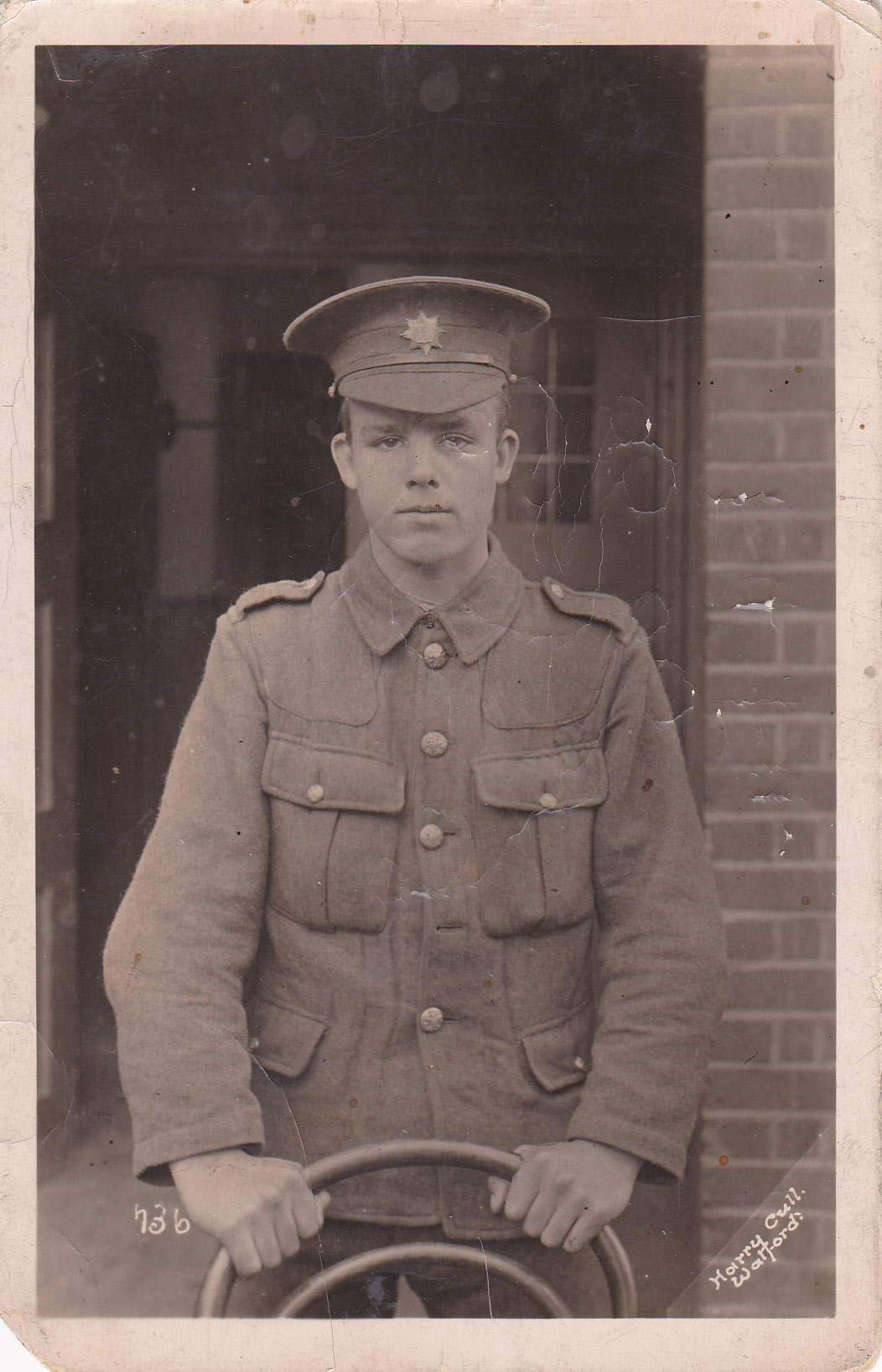
Alfred (Alfie) Eales was born on 12 August 1897 and lived with his family in Fulham. He was the third child in a family of 16 and the first boy. Eleven years and 5 sisters later he had his first brother.
In 1914 at the age of 17 he joined the 13th (County of London) Princess Louise’s Kensington Battalion The London Regiment (a Territorial Regiment) as Private 1592. Her Royal Highness the Princess Louise, Duchess of Argyll (6th child of Queen Victoria) consented to the use of her name by the Regiment and it became officially designated as the Princess Louise’s Kensingtons.
The regiment was mobilised soon after the declaration of the war on 5th August 1914 and was sent to Abbotts Langley. Men were allowed to join the Army from the age of 18, but were not sent overseas until they were 19. Alfie lied about his age as did many other youngsters.
The Kensingtons were sent to France on the 4th of November landing at Le Havre. On 1st December 1914 he was in the Sheffield Base Hospital with frostbite and talking to a reporter of the Sheffield Daily Telegraph about life on the front line.
“If Private Eales of the 13th London Regiment is typical of our Territorials there need be no fear of the way they will bear themselves in the field. He is an alert young fellow with merry eyes and an invincible habit of looking on the bright side of things. He was lying on top of his bed nursing his frost-bitten feet when a Sheffield Telegraph representative visited the Sheffield Base Hospital yesterday for the purpose of interviewing some of the wounded and invalided soldiers who arrived in the last convoy from the front.”
“There were some discomforts." he admitted, "but it was made up in other ways. Nothing to grumble at. There was plenty of food and everything and we played cards in the trenches. It will be better in better weather. We had plenty of cigarettes, could have opened up a tobacconist shop with them.”
"His six days in the trenches, he confessed were not a complete thing of joy. “It was wickedly cold. It was a clay soil, and the water would not drain away, and in some places when I was on guard, I was standing in a foot of water. The dug-out was dry but so cold that I could not sleep for more than half an hour at a time. It was exciting going into the trenches, for the Germans got an idea we were relieving the other fellows and chose the moment to make a charge. It was pitch dark, but we blazed away for about 20 minutes and they fell back when they were within about twenty-five yards of us. We liked the enemy to charge it was the only time we could get our hands warm. Rapid fire makes your rifle hot and that is comforting in this weather."
"The chief trouble we had from the enemy, however, was from their snipers. I managed to fetch one down from a tree. Either the Germans are not well fed or they have curious tastes for the first one I saw was reaching from his trenches for a mangold."
"The French people especially the poor were wonderfully good and were most self-sacrificing in the things they did for us. You couldn’t call the Germans exactly a nice race. I saw a French boy of about 8 in tears over his bicycle, some Germans had cut his tyres to pieces."
"My home is in London and I was wondering if I shall be there for Christmas. It is funny to think that I am farther away from home than I was at the front.”
During Alfie’s time with the Regiment, it saw action on the Western Front including the battles of Neuve Chapelle (1915), Aubers Ridge (the Regiment’s defining action in the War) (1915) and the Somme (1916).
The Battle of the Somme Roll of Honour records the following actions: 1st July Attack on Gommecourt Salient; 2nd Foncquevillers 4th September Fricourt Area; 6th Leuze; 8th South of Montauban; 11th Billon Farm; 22nd Maltz Horn Farm; 28th Morlancourt; 30th Fricourt Area; Early October Les Boeufs
Alfie survived for 2 years, but on the night of 4/5th October 1916 during the Battle of the Somme and at the age of 19 he was killed by a shell, at Les Boeufs, in Picardy.
A letter from his commanding officer to his parents dated 11 October 1916 gave details. He wrote:
“Eales was one of the best of my NCOs and his loss is a serious one to the company. Before his promotion he seemed a little irresponsible. This however was only excess of spirits, and with it all he was always a good soldier. But advancement as is so often the case with good men sobered him, and he did even better than I had hoped. He was always cheerful, capable and was a great favourite with officers and men alike.”
The letter referred to him as a Lance Corporal, although his death and memorial records show him as a Private. Alfie was buried in plot no II.Y.8 of the Guards' Cemetery at Les Boeufs, which is close to the river Somme, halfway between Amiens to the SW and Cambrai to the NE.
His name (A Eales) appears on the War Memorial Roll of Honour for the 1200 soldiers of the Regiment who died in the Great War. This is in Kensington Central Library, Phillmore Gardens, High Street, Kensington, London W8 7RX.
The motto of the Regiment was “Quid Nobis Ardui” which means “Nothing is too arduous for us” the motto of Kensington Borough Council.
A further memorial to the regiment is in the Church of St Lawrence, High Street, Abbotts Langley, England. This reads: “In memory of all ranks of the 13th Princess Louise’s Kensington Battalion The London Regiment who fell in the Great War. This tablet was given by their old comrades." The Battalion was stationed in this village prior to leaving to join the Expeditionary Force in France on the 3rd November 1914.
There is also memorial to Alfred on the grave stone of his parent’s (Alfred and Elizabeth} in Fulham Cemetery, Fulham Palace Road, London. Alfie was awarded three medals posthumously, the 1914 Star, the British War Medal and the Victory Medal.

DONATE TO OUR CHARITABLE FOUNDATION
Your donation supports projects like this one, which educate and involve future generations in remembering those who fell in the two world wars. Your support helps us keep their stories alive. Thank you.
